
At Yabuné, we processed six months of measurement data from the building management system of a 254-room hotel in Budapest: 185 nights, from February to August 2026. We were looking for the answer to how much energy is spent on rooms where no one is sleeping, and how much could be recovered from this.
The answer ended up being a number. The most instructive part, however, was the point where it became clear that the analysis had almost started on a wrong footing. The first results were Smarthome Beach 2026 presented at a conference; the full analysis can be found here.
The trap: the card sensor is not an occupancy sensor
Rooms have keycard holders, and their status is recorded by the system: a convenient, free substitute for „occupancy.” It seems obvious that if there’s a card in it, someone is inside.
The first run gave an occupancy rate of 91–98%. For a city hotel, this is an unbelievable figure on a half-yearly average, and if we were to believe it, the analysis would not even be relevant, since there would be hardly any free capacity. The explanation is simply that During the day, the cleaning staff also inserts their card. A fifteen-minute cleaning session gives the same signal as a three-day stay, and in the daily totals the two are indistinguishable.
The fix was to change the signal we narrowed it down to a night time window: between 00:00 and 06:00, because they don't clean at night. The result is a utilization of 73–86% – a realistic range – and what's even more convincing: the distribution of card presence at night purely dual-mode. The room either signals almost throughout the entire time window or not at all; there is hardly any intermediate value. This is exactly the signal shape we expect from a true occupancy signal, and which is completely smeared by the daytime data.
The first lesson, and the one that can be most useful elsewhere, is that checking wildcards is not a formality. It's not enough to have data: you also need to know if the data is what you think it is. A sensor that "almost" measures what you want is worse than a sensor that doesn't, because it gives you a confident, round, false result.
How much empty room is there and where is it?
With the checked signal, the image is as follows:
- On average 51 rooms, 20.1% of the room stock was unoccupied every night. The most was 140, the least was 7.
- Monday is the emptiest day (average 84 empty rooms), Sunday is the busiest (28). Classic business-urban pattern.
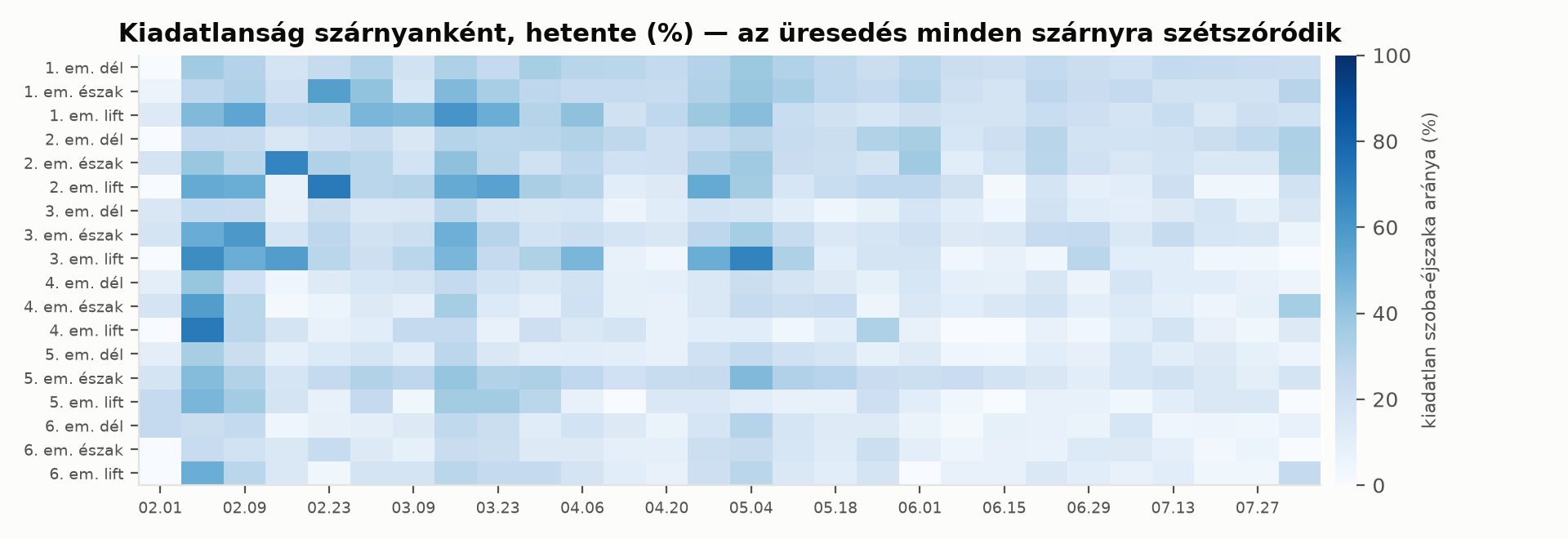
- The average number of empty rooms is They scattered from 18 wings to 13.4.
- Not a single entire floor was vacant on any of the 185 nights. Completely empty wings were rare, and only in the smallest units, with 4 to 8 rooms.
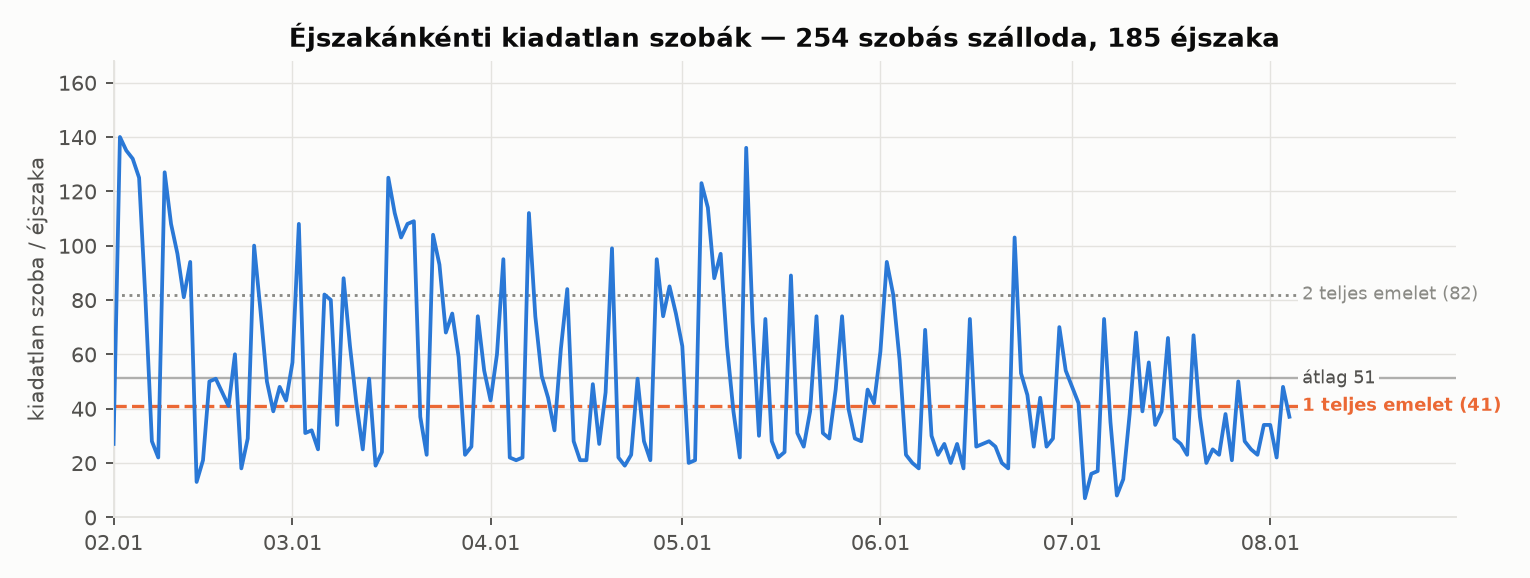
At first glance, this concludes the topic: there is nothing to stop, because there is no continuous empty unit. But the quantity is there. In 36% of time, there were enough empty rooms on at least three consecutive nights to fill an entire floor. It ran on two floors four times, for a total of 16 nights.
So the capacity exists, just in the wrong form. It's not missing - it's scattered.
What does a room consume when no one sleeps in it?
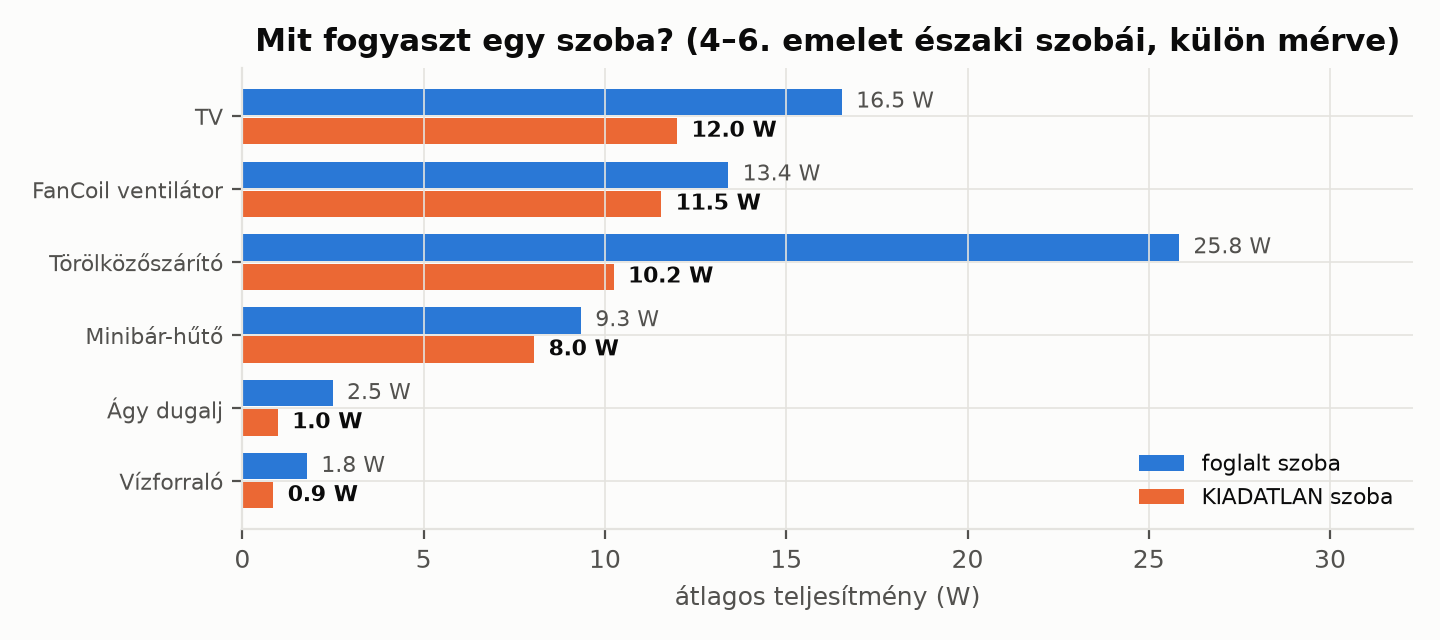
Measured daily average power: an occupied room 78.6 W, an unoccupied room 51.8 W. Breakdown of the unoccupied room: TV 12.0 W, fan coil 11.5 W, towel dryer 10.2 W, minibar refrigerator 8.0 W, lighting 8.7 W, sockets 1.9 W.
The consumption of an empty room is approximately 63% comes from devices that no one uses. This is thought-provoking in itself, but that's not the real point.
The most important measurement: cooling does not know about occupancy
The fan coils actual cooling operating time We also measured – not the fan's consumption, but how long it actively cools.
- In July, a unpublished room fan coil time 47.9%-in refrigerated. One occupied 47.4%.
- In August, it was 54.2% and 58.5%, respectively.
The system is practically in operation in the summer does not distinguish between rented and empty rooms. The hotel keeps rooms that are empty for days at full comfort level.
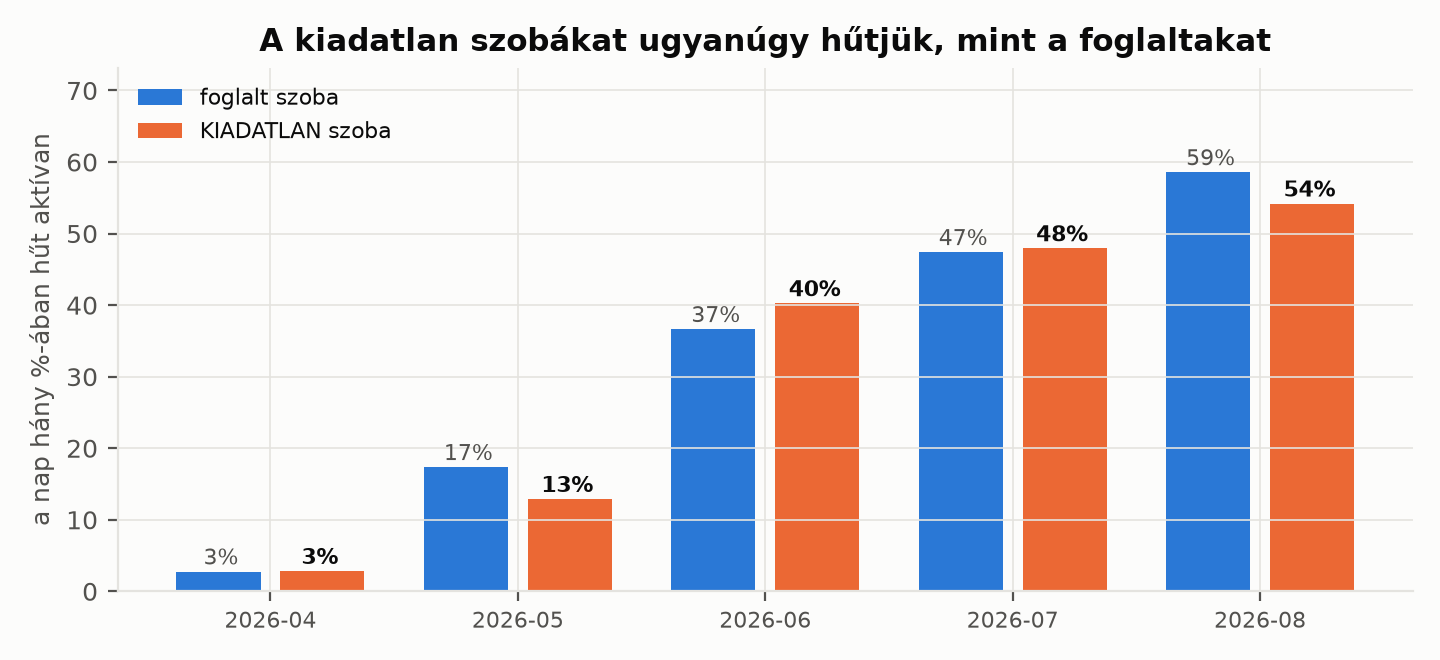
A counterexample shows that it is not a hardware issue: the But the logic works with towel warmers (7.2% operating time in an empty room, 15.1% when occupied). So the system is capable of it, the occupancy information reaches the control, it just hasn't been set for cooling. The solution therefore requires setup, not investment.
The second lesson is that The greatest waste is rarely where you look. The standby consumption of the TV is impressive and easy to communicate. An air-conditioned empty room is an order of magnitude larger item, but it is not visible on the room consumption meter because the work is done by the mechanical engineering in the machine room.
How much could you hold?
In the half year under review, the energy spent on unoccupied rooms was roughly 24,600 kWh was: 11,700 kWh of measured room electricity, plus approximately 12,900 kWh of estimated mechanical load.
If, with the same number of rooms available, the bookings had been arranged into entire wings and the units released three nights of fixed standby mode would have been applied – milder cooling setpoint, low fan speed, TV and minibar completely switched off, towel dryer disabled – then 8405 kWh could have been saved. This energy spent on unoccupied rooms 34%-a; on an annual basis, approximately 16,600 kWh.
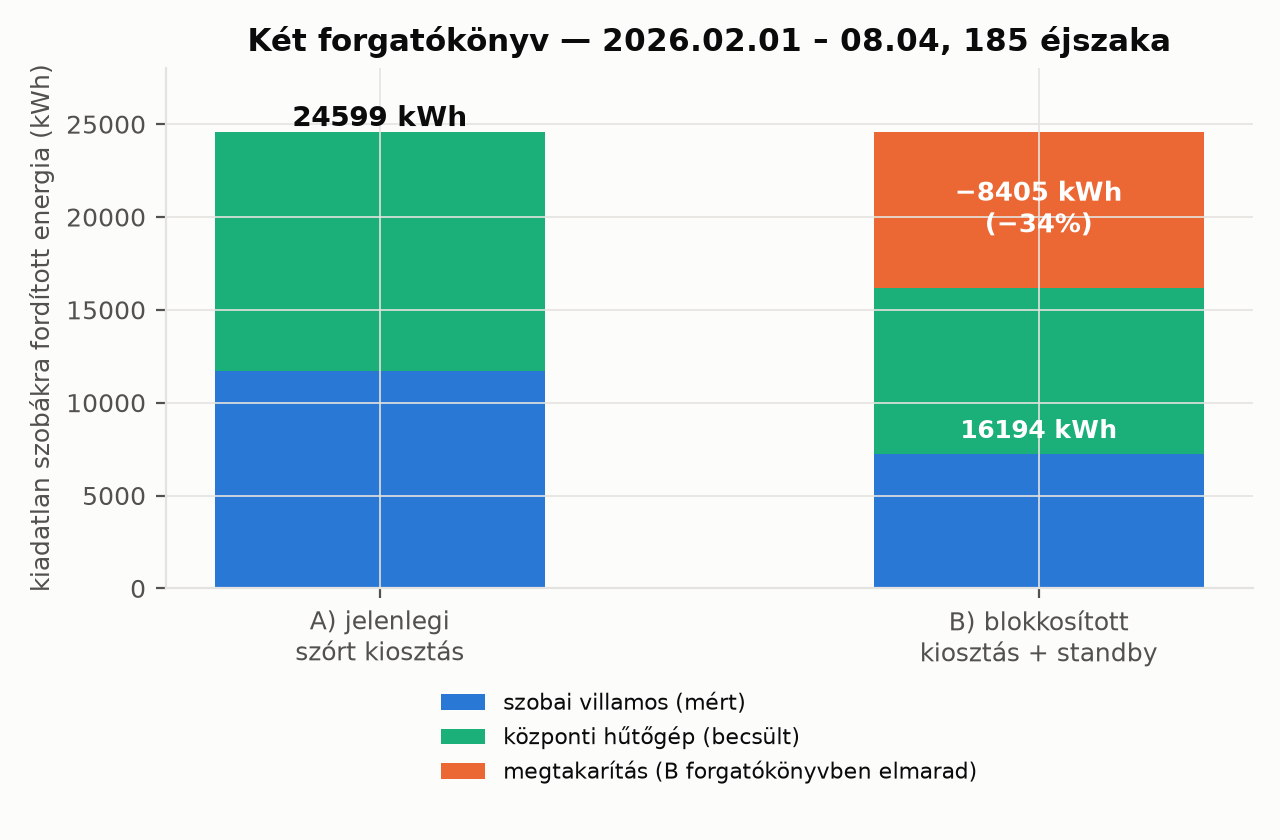
Why just blocked? Because a room that is randomly empty can be rented out at any time, so it must be kept ready: refrigerated, with a cold minibar. A closed, completely empty wing cannot. There, deeper back-regulation can be undertaken, because there is nothing to spoil.
The third lesson that follows from this is that This energy decision is not an engineering decision, but a reservation management decision. Room allocation is made at the revenue and front office tables, and typically no one there today thinks about energy costs. Fine-tuning the temperature setpoint is a negligible item in comparison.
This is not a theoretical question due to the timing: the Hungarian exchange (HUPX day-ahead) electricity price was on average 152 EUR/MWh in August 2026, compared to 80.5 EUR/MWh a year earlier. This is a nearly ninety percent increase in price in one year.
What this number does not include
8405 kWh is not uniform. Half of it measured value (4477 kWh): the consumption of the TV, minibar and towel dryer can be documented to zero in an empty room. The other half modeled estimate (3928 kWh, chiller side) and is based on three assumptions: the fan coil heat output is approximately 1.2 kW, the chiller COP is approximately 3.0, and standby mode halves the cooling operation time. Our analysis puts the total between 6400 and 10,400 kWh.
The most important limitation is that the analysis only covers the secondary side of the room and the cooling energy actually delivered to the rooms. Does not include primary page – the chiller's auxiliary equipment, primary and secondary circulation pumps, air handlers and ventilation, pipe network losses, and the poor part-load efficiency of the chiller. Eliminating an entire floor would also affect these, and according to realistic engineering expectations, twice as much in magnitude. The reported number is therefore a lower estimate, not a conservative average.
We also did not examine the operating and sales costs of blocking: the saleability of room categories, guest satisfaction, lost minibar revenue, and the quality of merchandise stored in a refrigerator that is turned off for days. These are real costs, and none of them are included in the above balance sheet.
The fourth lesson is that You can't optimize what you don't measure. There is no sub-measurement on the primary side, which is why the largest item is also the most uncertain.
The most important conclusion, however, is that the largest item – air conditioning of unoccupied rooms – can be grasped without blocking. There is no need to touch the reservation system: it is enough to recognize rooms that have been empty for several days based on the presence of cards at night and give them a milder baseline. The necessary infrastructure is already there in the wall.
We have written about hotel energy measurement before: How to save money and analyze a hotel's energy consumption?
At Yabuné, we design, build and operate smart home and building control systems, from single-family homes to hotels. If you run a hotel and want to see how much energy your empty rooms consume, Write down what you are preparing.: let's take a look at what your system already measures and what's worth adding.