This article is for you if:
- – in gross settlement or
- – you are in a balance but would like to optimally utilize the production of your solar system
- – you are tired of remotely connecting consumers and constantly monitoring production data to optimize – or if you have never cared about any of this
- – you don't have a battery but you have a solar panel and a number of larger electrical consumers (for example: electric water heater, electric boiler, electric car + charger (not the emergency charger!), electric hob, etc.
- – you have a battery for your solar panel, but on clear or summer days by noon it is often already charged to 100%;
- – your system does not feed back, or with gross billing you only receive about 4–5 forints per kilowatt-hour of fed-back electricity;
- – you have an electric boiler or an electric heating element in your hot water tank (this can also be the case in houses with gas boilers). If you have a continuous flow (combi) boiler without a tank, there is nowhere to put the heat, so this solution will not work for you.
Open your solar app and find a clear day! Look at the production curve where the battery reached 100%: if the curve flattens or drops from there – even though the sun is still shining – your panels are producing less than they could.
But this is not a mistake! If you cannot feed back into the grid – because your provider does not allow it, or because the system was/is set up this way – the inverter will throttle the panels back: the battery is full and the house is barely consuming power, but there is nowhere to put your excess generated electricity.
This solar energy is certainly lost, and the solar panel application only shows its symptoms: you see how much the solar panel produced, not how much. could have produced…
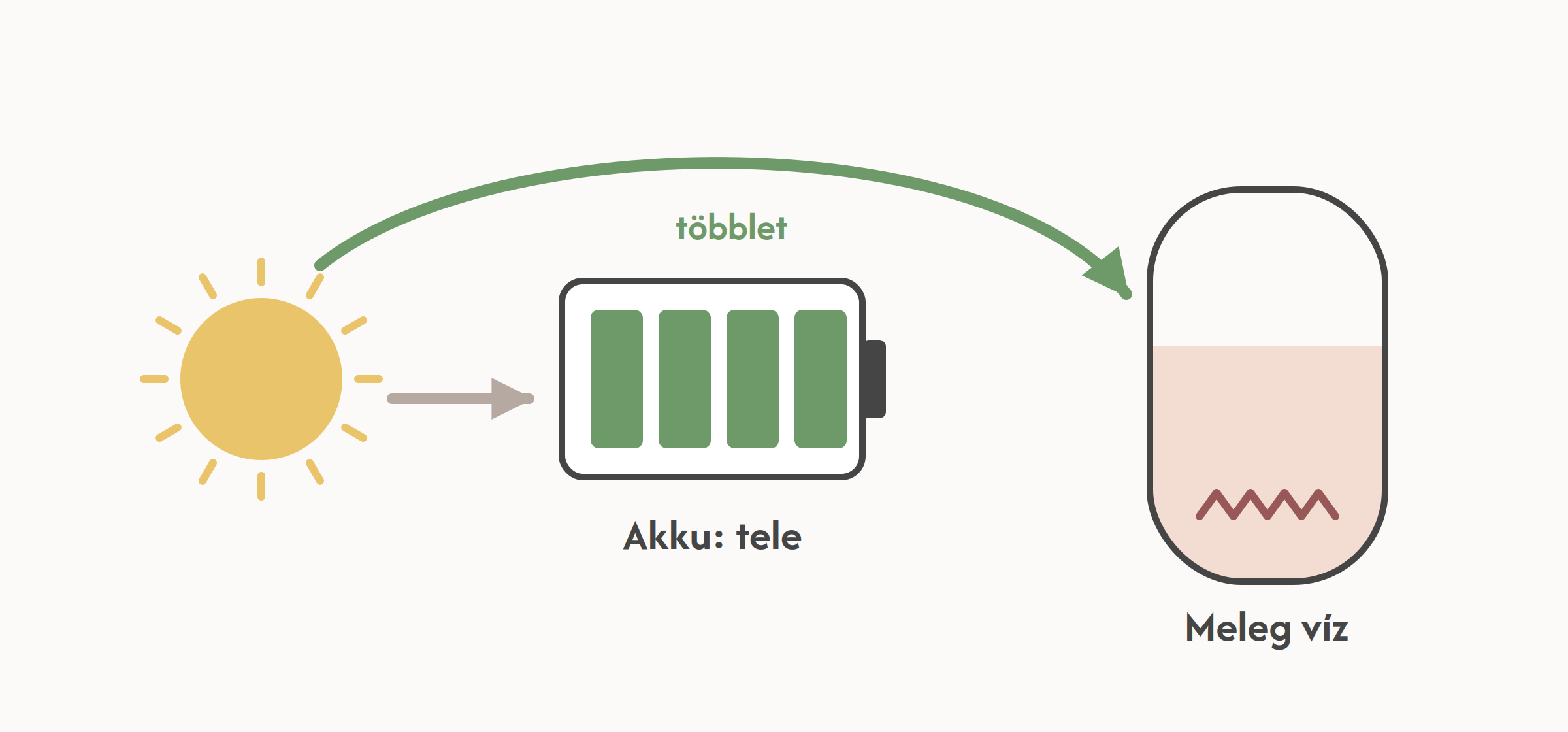
However, your water heater, electric car, and countless other household and home appliances could use it right now.
Let's look at the production of hot water as an example:According to our estimate, the solar energy currently being lost could cover a quarter to a third (approx. 25–33%) of the energy required to operate hot water production (with an electric heating element) in one year. This much less gas or purchased electricity may be needed for hot water. On sunny summer days, the rate is much higher, and in winter it is almost nothing. You can count on the annual rate if your battery is often full at noon on sunny days - with a smaller solar panel, without storage capacity or with high daytime consumption, it will come out less. The estimate only applies to hot water, not heating and total utilities. Where does the number come from?
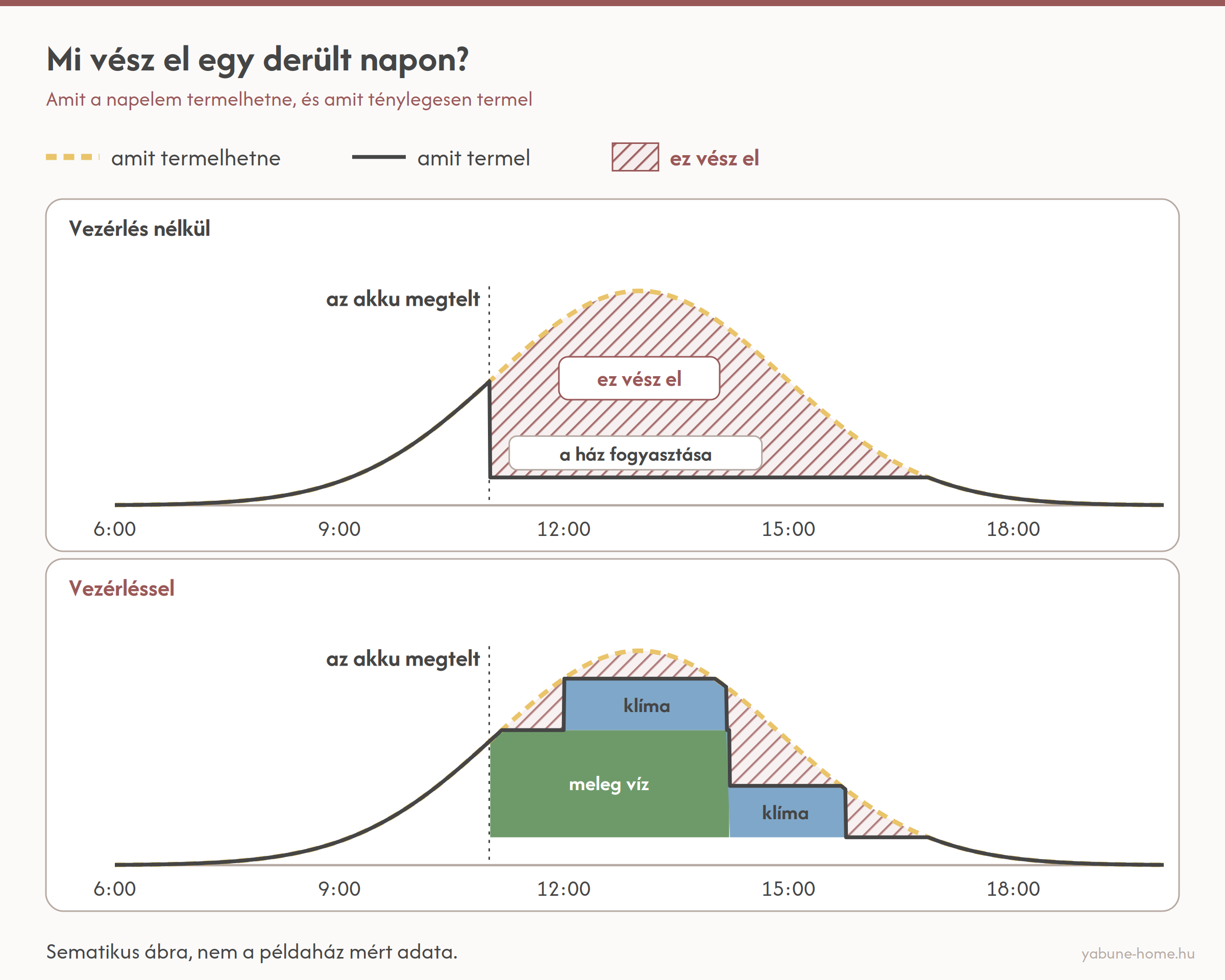
In the family home of one of Yabune Solution's clients, equipped with solar panels and a storage battery, we installed the Yabune Home control system, which directs this stored solar energy first to hot water and then to the air conditioners - a truly large consumer, with optimized conditions for "refueling" the electric car, which was an important condition for its use.
How much could this be worth to you?
In an average four-person household using about 200 liters of hot water per day (this is also the calculation used in the Slovak research), 25–33% is roughly the amount of energy needed for one family member's annual hot water use – just not evenly distributed, but mainly during the sunny months.
According to our estimate, at the universal service prices valid at the time of writing (October 2026) - excluding the cost of construction and any operating fee - it could cost approximately this much per year, depending on how the water is heated now:
- – with gas, if your annual gas consumption remains within the discounted limit (63,645 MJ per year, approximately 1,729 m³): approx. 9–12 thousand forints;
- – with gas, if you exceed the limit by at least approx. 4000 MJ (approx. 110 m³): approx. 65–90 thousand forints; if you exceed it by less than this, then the amount is between 9–12 and 65–90 thousand forints;
- – with an electric boiler, daytime (uncontrolled) electricity, if you stay within the discounted limit (2523 kWh per year): approx. 27–36 thousand forints;
- – with an electric boiler, on daytime electricity, if you are at least approx. 1000 kWh above the limit: approx. 53–70 thousand forints; if you are less than this, then the amount is between 27–36 and 53–70 thousand forints.
(Note: although we still have only a few measurement data available, it is already clear that in the relatively sunnier period between mid-September and mid-October, with the Yabune Home-controlled and energy-storing solar panel system, the household's electricity consumption can be measured at approximately 20-25 % lower than in the usual period at this time. The measurement is based on a system available through an NPP tender: 15 Kw solar panel, 5 Kw inverter and 10 Kw storage battery. The household's major consumers include 2 inverter refrigerators - air conditioners, 1 DHW buffer tank with electric heating element, electric oven and hob, washing machine and electric car (with 55 Kw batteries.)
The cost is lower if your boiler has been partially powered by solar panels or batteries. The connection is also different for controlled (night) electricity; if you stay within the discount limit, it will cost about 17–23 thousand forints, but above the limit you have to calculate individually.
In the case of gross settlement, you must deduct from the above amounts what you now receive for the re-fed electricity: approx. 3–5 thousand forints per year. In the case of a balance settlement, the excess is not lost, it must be settled individually. (The deduction is made in the „Where does the number come from?”" section.)
Why isn't a timer set to 12 noon enough?
- – The timer does not know whether the sun is shining and whether the battery is full. If it is cloudy during the day and at noon that day, the battery is still charging, the boiler would take away the solar energy, and the remaining deficit would be made up from the battery or the network. Moreover, there is no indication of how much unused solar energy is lost in clear weather – it has to be estimated.
- – The house’s load cannot handle just any amount. Many single-family homes receive electricity through three phases, and each has its own power limit. If the hob or oven is running, plus the washing machine and kettle, another large consumer (say, the car) can trip the fuse. (There are already chargers on the market for this, so-called „smart chargers” that monitor the house’s consumption – however, although these devices are obviously useful, they obviously do not provide optimized control of the building, they were not designed for this – but they can prevent the tripping of the car.)
- – And the battery can't be drained because of it. If the boiler is heating even when there is no surplus, it draws power from the battery.
What does the controller see – and what do you see on your phone?
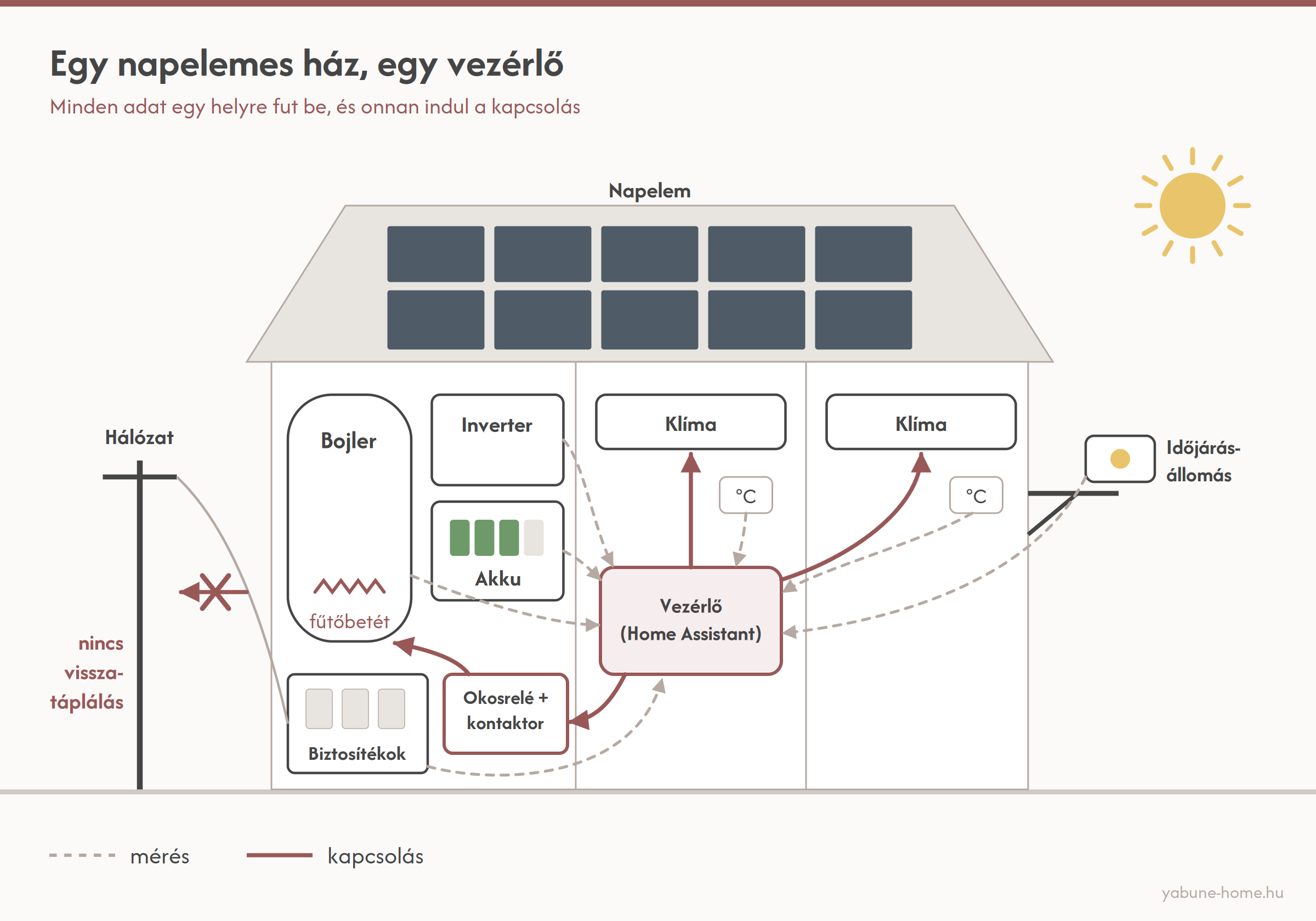
At the center of the system is a smart home controller (in our case, it's the Yabune Home system based on Home Assistant). The controller sees how much the solar panel is producing, how full the battery is, how hot the heating water is in the buffer tank (if any), how hot it is in the rooms, and overall how close the house is to the consumption safety limit. (If these are not already measured, this can be easily remedied by installing a few sensors - even as a retrofit, i.e. without dismantling.)
This turns on the hot water tank heater or the air conditioner for heating/cooling. It does not touch the inverter settings, it just reads its data.
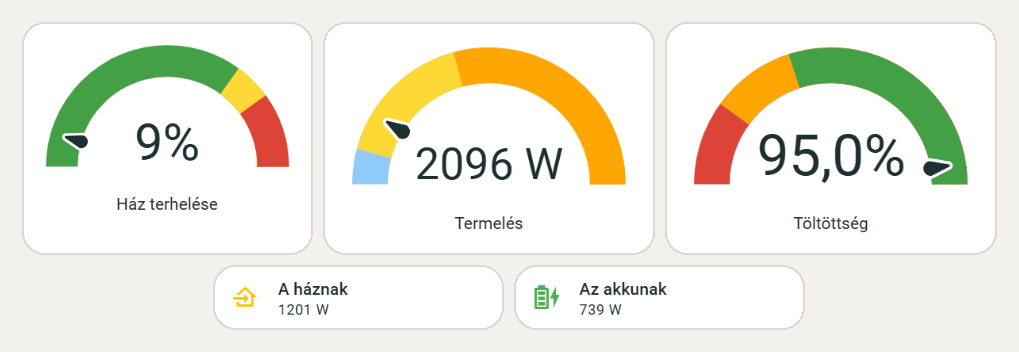
You can see the same thing in the Yabune Home user interface, and that's useful in itself: it shows when your house is close to the limit, and you can track how much electricity you've used from the grid this month.
How does the system know when solar energy is being lost?
It's pretty much the same as the curve above: it compares how much sunlight there is and how much the solar panel produces. The sunlight is measured by a small weather station: from this the control calculates how much the solar panel could produce. If the battery is full and the actual production is much less than this, the difference is lost.
The estimate is only an indication – the decision depends on a test. The control turns on the heating element and monitors the battery. If the battery starts to drain noticeably, there was no real surplus and the control stops the heating. So the calculation may be wrong, but an unnecessary test will at most only take a little energy from the battery.
Details for professionals
- The controller only assumes a hidden surplus if the battery is almost full and barely charging, and the sun is up and shining strongly.
- Surplus = estimated production (capped at the inverter's rated power) minus the house's current consumption.
- Estimated production is derived from irradiance and a self-tuning coefficient, and can't exceed the rated power of the PV array. The coefficient adjusts slowly and continuously to actual production – but only while the battery is still charging, i.e. when the inverter is definitely not throttling the panels.
- Stop signal: the heater has been running for a while and the battery is noticeably discharging on a few-minute average. The start decision is based on the 15-minute average of available power, because inverter data arriving via the manufacturer's server lags by several minutes. If the inverter is at its output limit, a small part of the energy during the test may come from the grid.
Why does hot water come first?
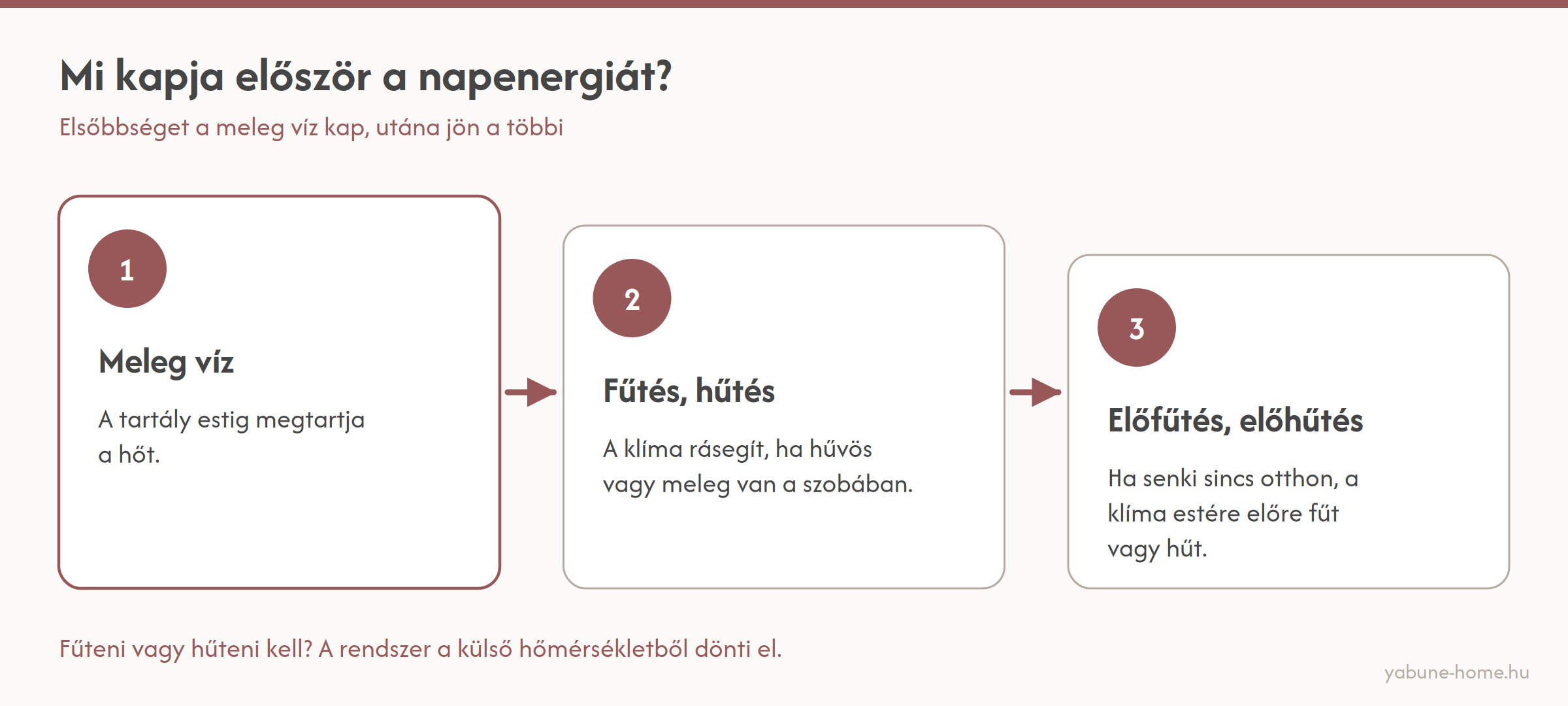
Because the hot water tank is like a second battery, only it stores heat instead of electricity: the sun charges it at noon, and the water stays warm in it until evening.
If the water is already hot, or the excess is still not enough for the heating element, the air conditioner will get some of it – provided that the room is cooler or warmer than it needs to be. If no one is home during the day, the air conditioner will preheat or cool a little in the evening, so that less energy may be needed in the evening. Of course, a favorable prerequisite for this is the proper insulation of the house / building, in terms of windows, walls, attic space, and basement, as this way the energy stays inside.
Details for professionals
- Tank: starts when the water is a few degrees below the set upper limit (e.g. 60 °C) and the surplus covers most of the immersion heater's power. If there's plenty of surplus, the tank and the air conditioner can run at the same time.
- Air conditioner: starts when the surplus is about 1 kW and the room temperature differs noticeably from the set comfort temperature. Pre-heating and pre-cooling: only during the day when nobody's home; 1–2 degrees warmer in winter, about 1 degree cooler in summer, within reasonable limits.
- Heating or cooling: the controller decides once a day, based on the 24-hour average outdoor temperature. Heating in cool weather, cooling in warm weather; in the transition between the two, the air conditioners don't start. To keep the system from flip-flopping, heating and cooling only end with a small margin.
What protects your house – even if the controller freezes?
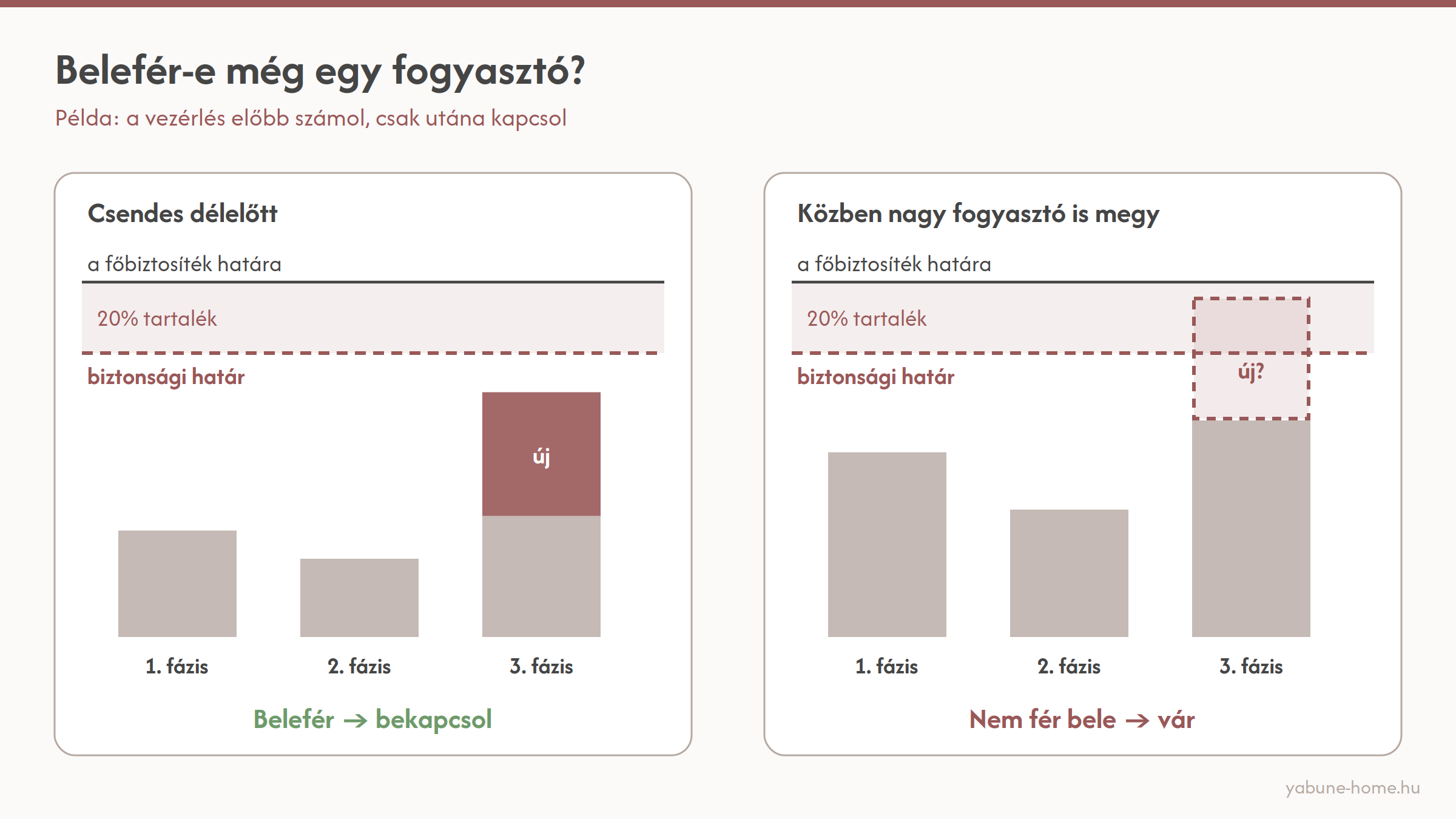
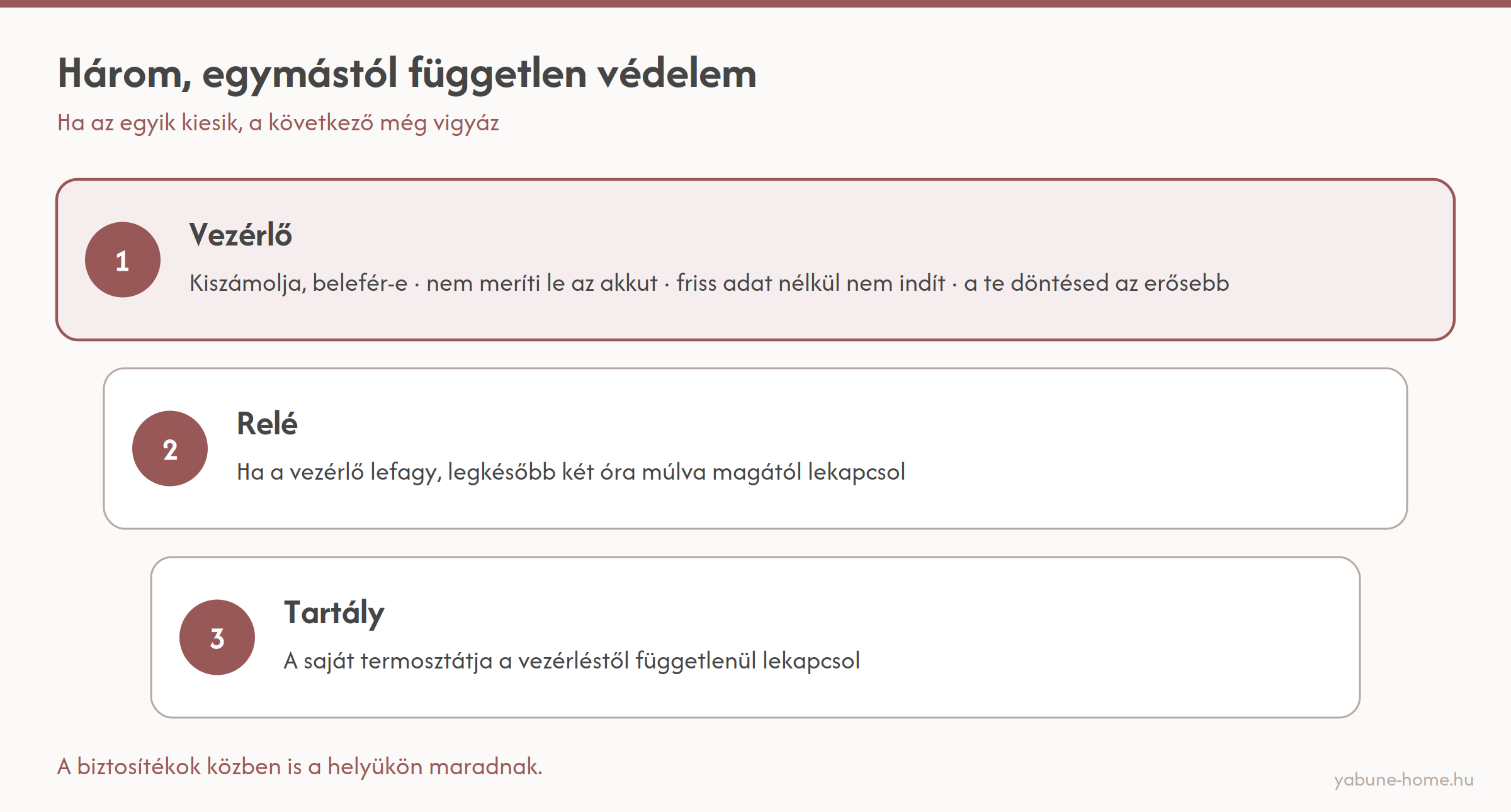
A mindless switching automation does more harm than good. Therefore, the controller only turns something on when it has calculated that it can fit into the house wiring, including the reserve, and when the battery is almost full - because it will be needed as a night reserve or to charge the electric car in the evening. So if any phase goes above the limit, or the battery is heavily discharged, it will stop what it has turned on within a few minutes; if the battery is only slowly draining, the device will continue to run for about twenty minutes from start-up, and then stop. If there is no fresh data from the inverter, the controller will not start a new one, and it will stop the tank heater it has turned on.
The manual decision is stronger: what you turn on manually, the controller does not turn off, and the climate you set will be left alone for two hours. If you do not want to touch the tank at all, you can disable it with a switch on the Yabune Home interface. If the controller itself freezes, two other protections continue to work on the tank: the smart relay that operates the heating element switches off by itself after two hours at the latest, and the tank's own thermostat stops the heating at the set temperature. There is no such timer for the air conditioner: in this case, the air conditioner continues to operate at the last set temperature, and you can turn it off with the remote control. Fuses still protect against overload: the controller sees the load on the phases with a delay of a few minutes, so it tries to prevent tripping, but it cannot replace the fuses.
On sunny days, though, you may notice the water is hotter than usual. Without a thermostatic mixing valve, there's a risk of scalding at the tap – we check this during the site survey.
Details for professionals
- Limit: it only starts something if the most heavily loaded phase, including the new load, stays below 80% of the main breaker's rated current; the remaining 20% is the safety margin. Phase current is calculated from phase power and voltage, because the inverter's “grid current” value often only shows the current at its own connection. The calculated value may be slightly lower than the actual current; the margin covers that too. If any phase exceeds the limit, the controller switches off its own loads as soon as it sees this in the data, which sometimes arrives minutes later.
- Battery protection: only starts with an almost full battery; if the charge drops noticeably or the battery is discharging at high power, the controller switches off its own loads as soon as this shows up in the data.
- Stale data: if the inverter or tank-temperature data hasn't updated for several minutes, the controller doesn't start anything, and switches off any tank heating it turned on.
- Scheduling: unless there's a reason to stop immediately, a device runs for about twenty minutes, and after stopping it waits a while before restarting. At least 15 minutes pass between two starts, and only one device starts at a time.
- The immersion heater isn't switched directly by the small relay, but by a contactor – a switch rated for high current, mounted in the distribution board.
- The immersion heater's consumption isn't metered separately. A few minutes after starting, the controller checks whether the house load has risen by roughly the heater's power. If not, it assumes the tank thermostat has already cut out (the water is hot): it switches the heater off and doesn't try again for a few hours.
- The relay's own timer is set to two hours; while the heater is running, the controller restarts it every hour, so the timer only kicks in after a failure or a manual switch-on.
- Disabling the tank is software-only, not electrical isolation: before any work on the immersion heater, the electrician de-energizes the circuit with its circuit breaker.
Does the controller start switching things on right away?
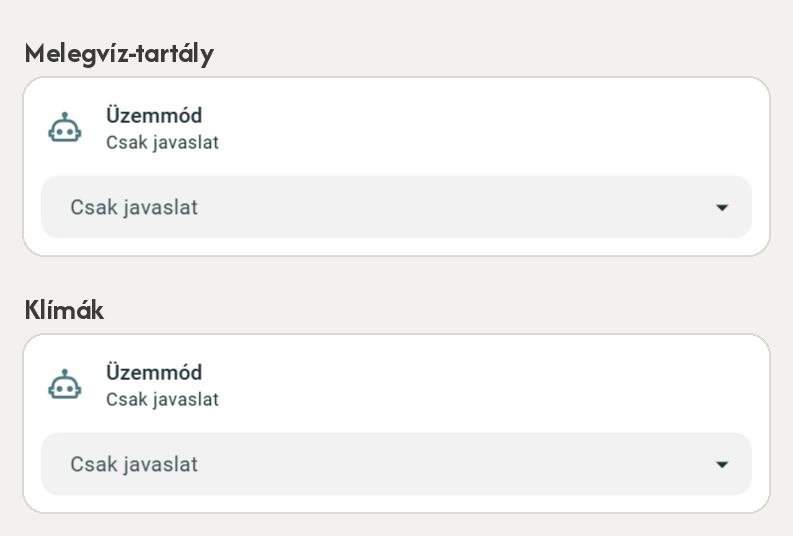
No. The hot water tank and the air conditioners have three separate settings: „Off”, „Suggestion only” and „Automatic”. In the first few days, the control only describes and suggests what to turn on – this way you can see if your calculations are correct. After that, we switch the hot water tank to automatic mode, and only later, the air conditioners one by one.
What will you notice?
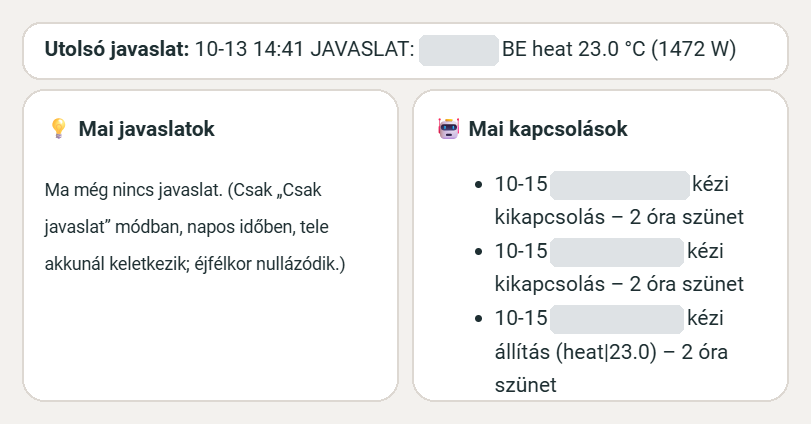
We designed the operation so that you hardly notice anything in automatic mode: the only thing is that on clear days at noon the air conditioner starts by itself, and in the afternoon the water in the boiler / tank is warmer than before. If there is no surplus, the water is heated by the boiler or boiler as before - at most a little later or to a lower temperature, because we leave room for solar energy during the day. By default, you will not receive notifications about the control's switching - if you are curious about it, you can check what was turned on that day - or what would have been turned on - on the Yabune Home interface, as these are logged.
What do you need – and what do you already have?
The elements required for the above operation are: solar panel with hybrid inverter and energy storage battery, electric boiler or hot water storage with electric heating element, and at least one cooling - heating (controllable) air conditioner.
What we add to this:
- – installation of a small control device that we configure;
- – an outdoor weather station and room thermometers;
- – a smart relay and a switch (contactor) designed for high current consumption in the electrical cabinet – these will be connected by an electrician(s);
- – a power meter if the inverter does not measure the house load per phase.
We set the boiler or water heater so that there is room for solar energy during the day, but there is hot water on cloudy days - and even if the controller fails. If the data of your hybrid inverter is available from the cloud (typically yes, since the installation company also sees it for maintenance and support purposes), you typically do not need to buy a new inverter or battery - we will check this in person during the survey.
Details for professionals
- The inverter's data must reach the controller.
- The smart relay can be a Shelly, for example. The immersion heater must be on its own circuit, protected by its own circuit breaker.
- The air conditioners need to be connected to the controller.
- For electric water heaters, covering cloudy days means the heater must also be able to heat independently of the controller (e.g. on a timer).
Where does the number come from?
The ratio at the beginning of the article is an estimate, not a measured value: in the family house in the example, the control is only a suggestion, so we cannot provide full, annual or semi-annual specifics for now (but we promise we will return to the topic 🙂). .
- Slovakia, measurement: a PV array of about 2 kWp, with no battery and no household consumption, heating only a 200-liter hot water tank. Over a year it supplied heat equal to about 44% of the calculated hot water demand (calculated from the study's data; Matuska and Sourek, 2017).
- Switzerland, calculation: in a six-apartment building where solar power first supplies the household, then the car, and finally water heating, about 79–93% of the hot water could come from solar in July, and none in January. The authors used a monthly balance and consider this optimistic themselves (SPF/OST, 2024).
In both studies, more solar energy could have reached the water than in our case. In our control, the heating insert only receives electricity if the battery is full after supplying the house (since we store it for the night first), and the free power is large enough; and the tank can only hold as much heat as the boiler or water heater setting allows. Therefore, for the 44%, we are more cautious, calculating approx. 25–33%.
Less may be achieved if the solar system's production is low, the house consumes a lot during the day, or the battery is rarely filled. The warmer tank loses slightly more heat; this is partly why we calculate cautiously. The figures do not include the cost of construction and any operating fees, and we did not include the energy used by air conditioners in the savings.
How we calculated the forint figures: Water heating for a four-person household requires approximately 3,000 kWh of energy per year (this is also calculated in the Slovak measurement), so approximately 750 kWh per family member. A quarter – a third of this 3,000 kWh is approximately 750–1,000 kWh. For an electric boiler, we multiplied this by a price of approximately 36 HUF/kWh within the discount limit, approximately 70 HUF/kWh above the limit, and approximately 23 HUF/kWh within the limit for regulated electricity.
For a gas heating/warming system with a boiler efficiency of approx. 90% (obviously assuming a higher quality boiler), this is 3000–4000 MJ of gas; within the discount frame, we calculated 2.9 HUF/MJ, and above the frame, the market price of 22,002 HUF/MJ (this is more than seven times the discount price).
Amounts above the limit are only fully valid if you remain above the limit even after the savings. The feed-in fee that is deducted from the gross settlement is calculated at approx. 4.4–5.3 HUF/kWh for 750–1000 kWh.
Charging the electric car
Since most places have batteries (storage units) in operation that can be obtained through state tenders, we can usually count on a solar panel capacity of around 15 kW, an inverter output of around 5 kW and a battery storage capacity of around 10 kW.
Since many people buy an electric vehicle as a second car in the family – for now – so in the case of this type of use (thinking about average e-cars), in the ideal case (a sunny day in late spring – summer – early autumn), the 10 kW of energy stored in the battery in the evening may be enough to operate the vehicle with solar energy, since the car's mileage during the day is approx. under 100 km (e.g. going to work in the agglomeration, picking up children, shopping, etc. – so smaller trips) – and there is still a night reserve for operating the house (since it is not worth and should not be allowed to drain a battery to zero percent every day if we want to reduce degradation as much as possible).
For those who use the e-car for commuting to work further away as their primary vehicle and with larger batteries (located in the car), the stored solar energy will obviously be used up at night, reducing home charging costs.
If the vehicle is at home and the solar panels can produce at full capacity, a truly fully optimized and equipped family home (or apartment building) can produce a large part of the required amount of electricity locally for a significant part of the year - and reduce the expected electricity (overhead) costs for the remaining time. In these cases, the control frees us from the time-consuming and attention-consuming control between monitoring production and switching between usage modes, since the control does this faster and more accurately in the background.
Obviously, such an investment is worth calculating in advance, as in addition to environmentally conscious considerations, we also have to take into account the expected payback period, and in the field of updated e-cars, it will slowly be possible to plan at home with the VTL function, which can also mean additional battery storage capacity - and not a little!
Is your curve flattening out too?
According to our estimate, the solar energy currently being lost could cover a quarter to a third of the energy needed for water heating (approx. 25–33%) in one year. (hot water only; yours may differ). The house data will show you exactly how much.
At Yabuné, we design, implement, and operate smart home systems, and we would start this control with suggestions for you first, then fine-tune it if necessary, and only then could it work automatically.
If your consumption curve is also flattening and you would like to make better use of the energy you produce – use it get in touch: send a screenshot of the production curve for such a day and write what type of inverter, battery and boiler you have - if you don't know, the name of your contractor will also help.
From this, we can estimate roughly how much solar energy you are losing and what would be needed for control.
We look forward to your application, we are happy to help - so that you can use the energy locally, in the most economical way possible! 🙂