Yabune Hotel Solution
Room-by-room heating and cooling control, energy management with per-room metering, and an analytics interface you can simply ask about your hotel’s data.
Yabune Hotel Solution is built for hotels, holiday parks and guesthouses. Control runs locally on the hotel’s own network, and we operate it: we monitor the system, take fault reports from the maintenance team and, if needed, fix things on site.
Live data from the systems we monitor.
Where it runs
Danubius Hotels
Hélia, Annabella and Aqua (Budapest) and Bük: room control, energy management, operation and support.
Villapark, Várgesztes
Heating for 122 villas, 15 pools and 37 air conditioners on one interface.
Chez les Amis guesthouse
Five guest units.
What the system does
Room control
Every room has a thermostat whose adjustable range can be limited to the hotel’s rules. Fan coils, air conditioning, radiators and towel heaters work in one system; when a window is opened, heating and cooling stop.
Energy management
Rooms can be switched to energy-saving mode centrally or by rules. Each room’s consumption is metered, so you can see where energy is being wasted.
Operation and support
We monitor room status continuously. Automatic fault detection flags when a device drops out or a room doesn’t reach its set temperature. We take reports from the maintenance team directly and document every repair.
Runs locally
Control runs on the hotel’s network and keeps working during internet outages. Remote access follows the hotel’s IT security rules.
Central management interface
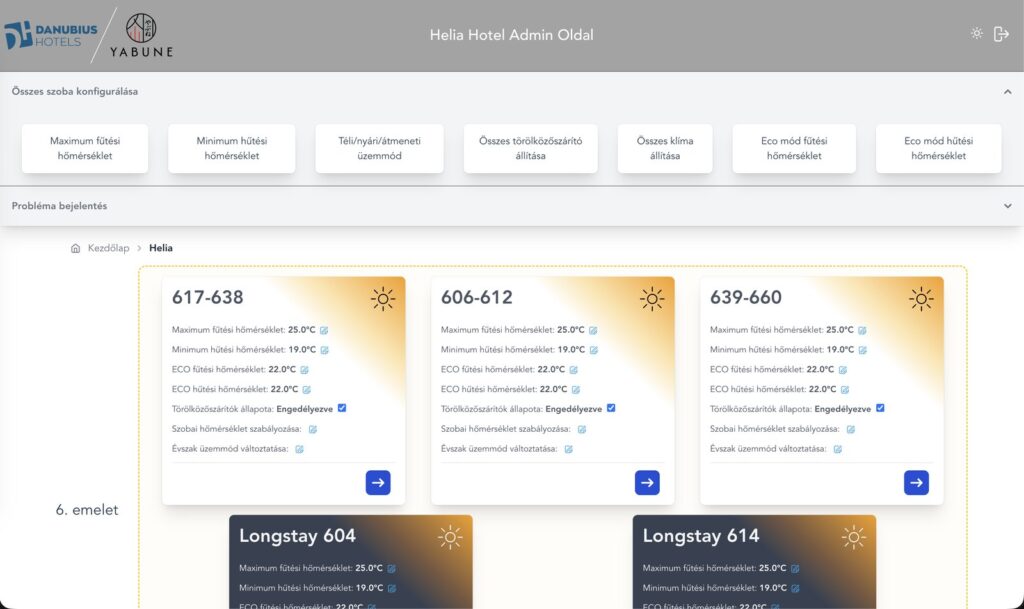
Hotel operations set the rules on a central interface: maximum heating and minimum cooling temperatures, winter, summer or transitional mode, energy-saving temperatures and towel heater operation. Rooms can be grouped – for example long-stay rooms or rooms under maintenance – and a setting applies to the whole group at once. Floor-level control views open from here too, where reception and maintenance see thermostat status, open windows and consumption room by room.
How it fits together
- Roomthermostat, fan coil or AC, window sensor, key card holder, energy meter
- Room gatewayZ-Wave JS, over Wi-Fi
- Local server on the hotel networkHome Assistant and MQTT on a Kubernetes cluster: control, energy-saving mode, fault detection
- Hotel analytics and AI assistantMicrosoft Azure, European region
What it is built on
We build on open, widely used technologies and devices from proven manufacturers, so the system is not tied to a single vendor and works the same way in every hotel.
In the room
On the hotel server
In analytics
Hotel analytics with an AI assistant
Data from the rooms – temperature, consumption, door and window openings, key card use – is collected in a hotel analytics interface. It flags faults automatically, and its AI assistant can be asked questions in plain language: which room is using the most power right now, or where a window is open while the air conditioning is heating. The connected AI model can be swapped, and we process the data ourselves in Microsoft Azure’s European region. In summer 2026 the analytics interface ran as a pilot in all four Danubius hotels.
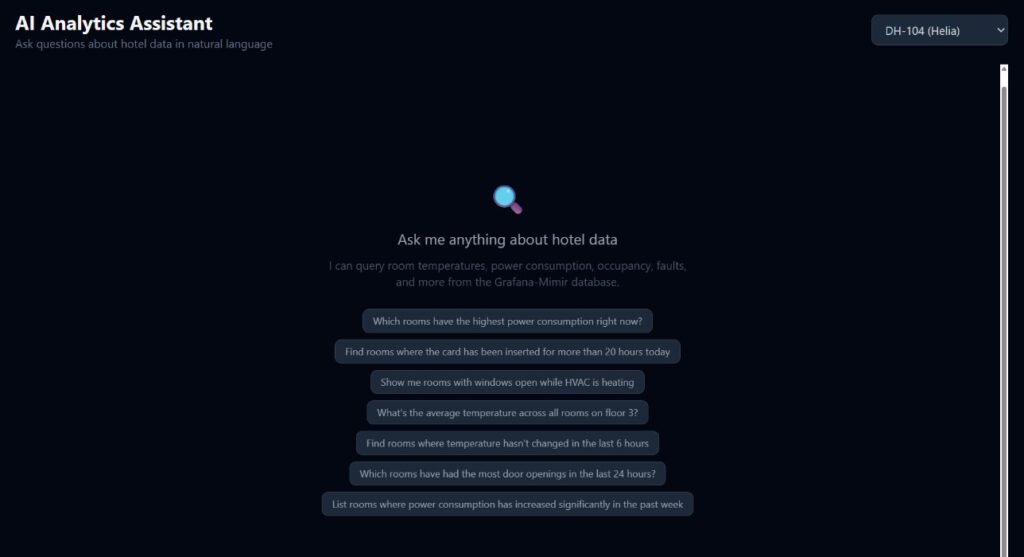
Hotel analytics dashboards
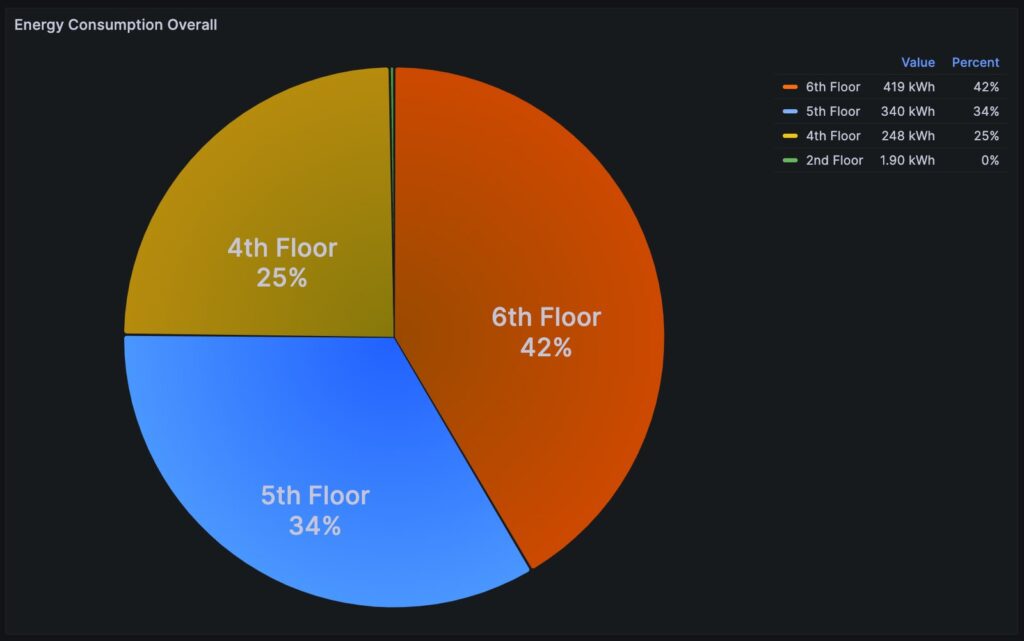
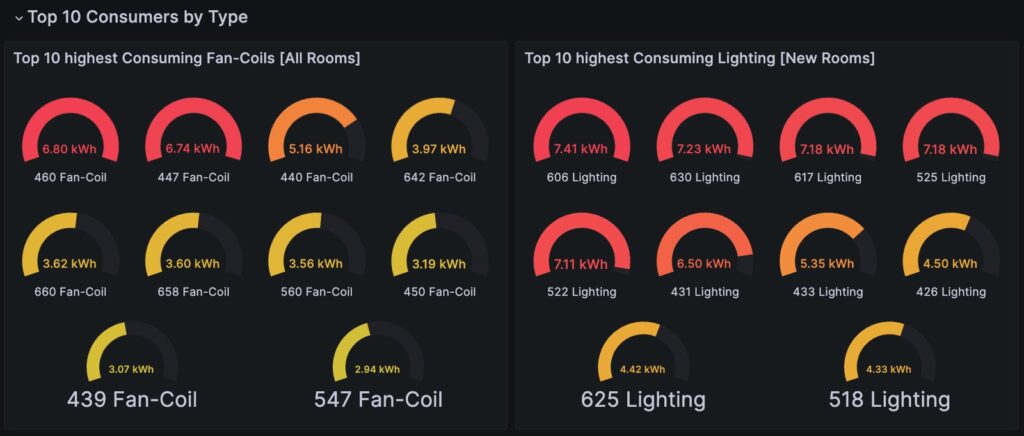
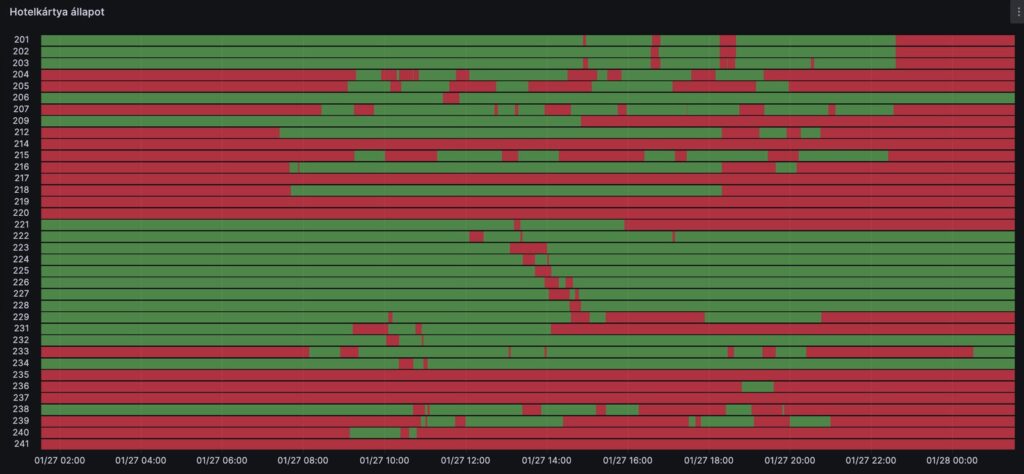
The measured data feeds Grafana dashboards: consumption by floor and by room, the biggest consumers by device type, and the status of the key card holders room by room.
What the measurements show
In a 254-room hotel we measured fan coil running times for six months: in summer, empty rooms were cooled just as much as occupied ones. That’s why we are working on linking room control to the booking system.
Planned: connection to the booking system
Once the system is linked to the hotel’s booking system (PMS), rooms switch to energy-saving or comfort mode according to bookings, before guests arrive. At Danubius this is scheduled for the first half of 2027.
We have also presented the solution at Z-Wave Alliance events (Barcelona, 2024; Vienna, 2026).
Running a hotel, holiday park or guesthouse? Tell us how many rooms you have and what works today.