
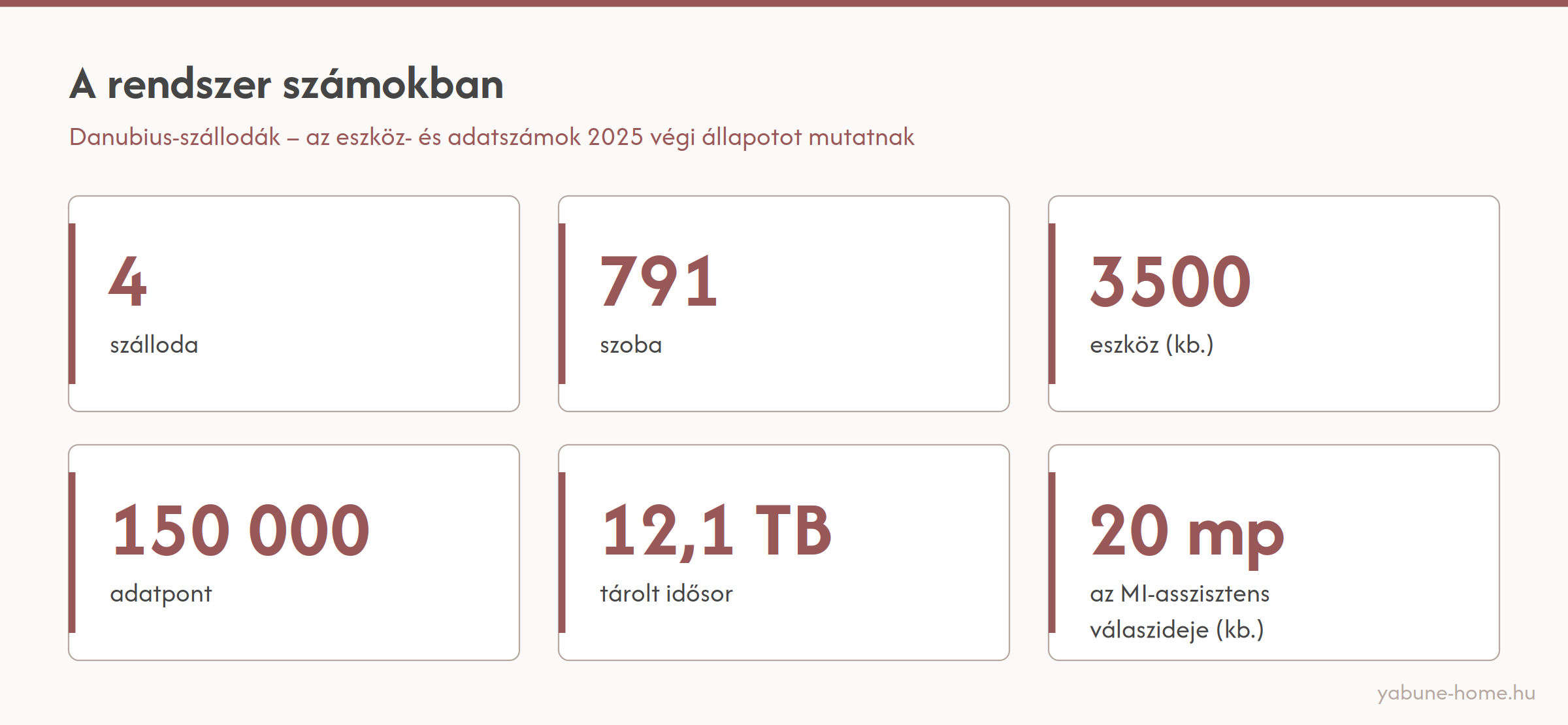
In four Danubius hotels – Hélia, Annabella, Aqua and Bük – a total of 791 rooms operate with the Yabune Solution system. In each room, continuous measurements are made: temperature, fan coil status, window and door opening, card presence, consumption. So the data is there. The question is who has access to it and how.
The user interface shows what we have planned in advance. However, the operator always has a different question: in which room was the window open while the fan coil was heating? Where has the temperature not changed for six hours? Today, an AI assistant answers these questions in about twenty seconds – and its answer can be checked.
Why is this harder than it sounds?
- There is a lot of data. In the four hotels approx. 3500 devices and 150,000 data points produce time series, the stored data 12.1TB. You can't search for it manually.
- The interface does not respond to occasional questions. Every new question would require a new panel, and by the time it's ready, the question is no longer relevant.
- The one who asks does not write a query. The measurement database is accessible in its own query language (PromQL). No one at the reception or in the technical department wants to learn this – and no one needs to.
How does it work?
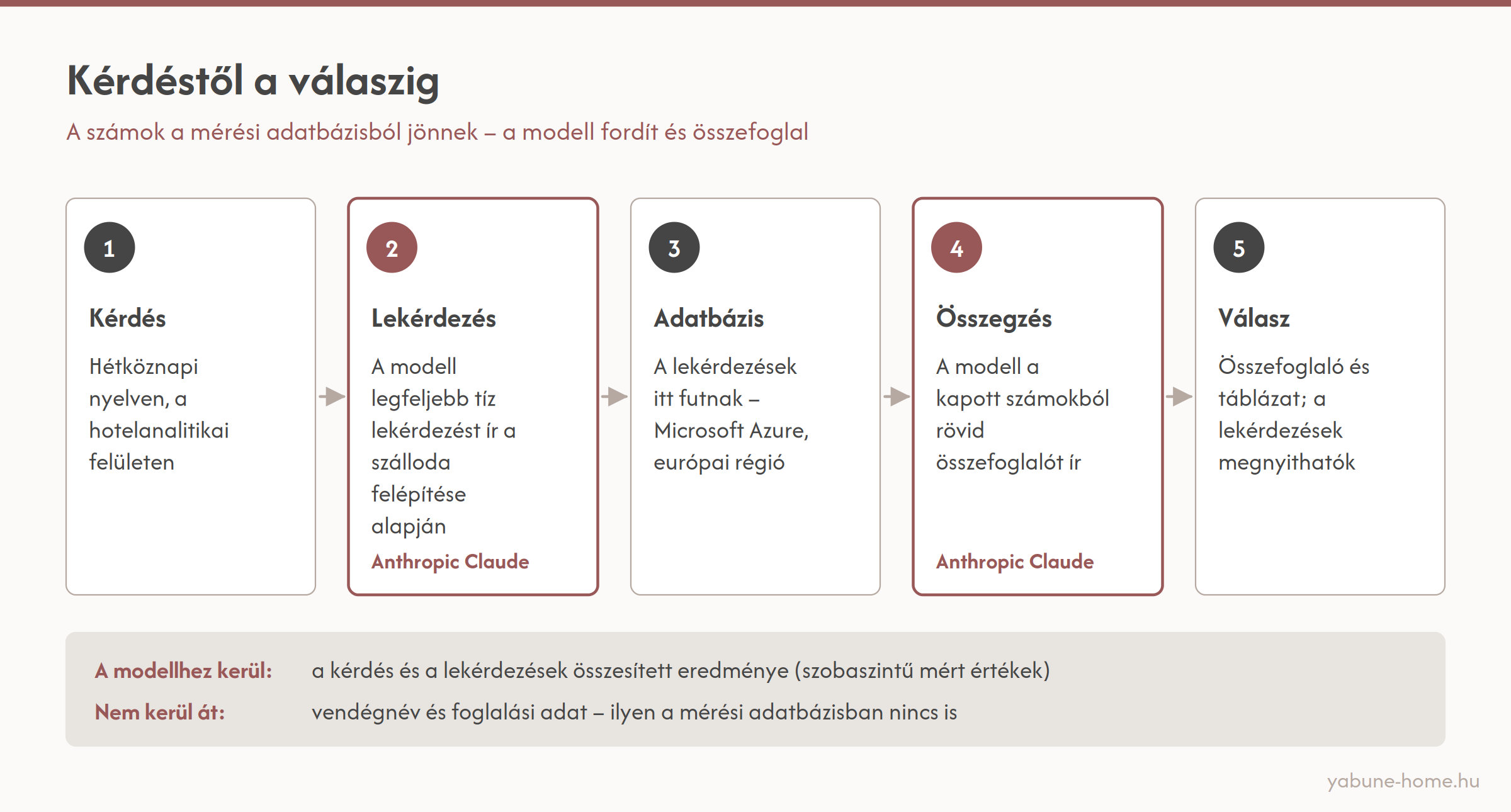
The question can be asked in natural language. The assistant is powered by Anthropic Claude's language model, in two steps:
- The model writes up to ten database queries from the question. It knows the structure of the selected hotel: how many rooms it has, what amenities are in the rooms, and how these are listed in the database.
- The queries are run on our own measurement database. The model then creates a short executive summary and table from the received numbers.
The numbers don't come from the model, but from the database. The model translates the question and summarizes the result – it does not invent the measurement.
The system in numbers
A real question
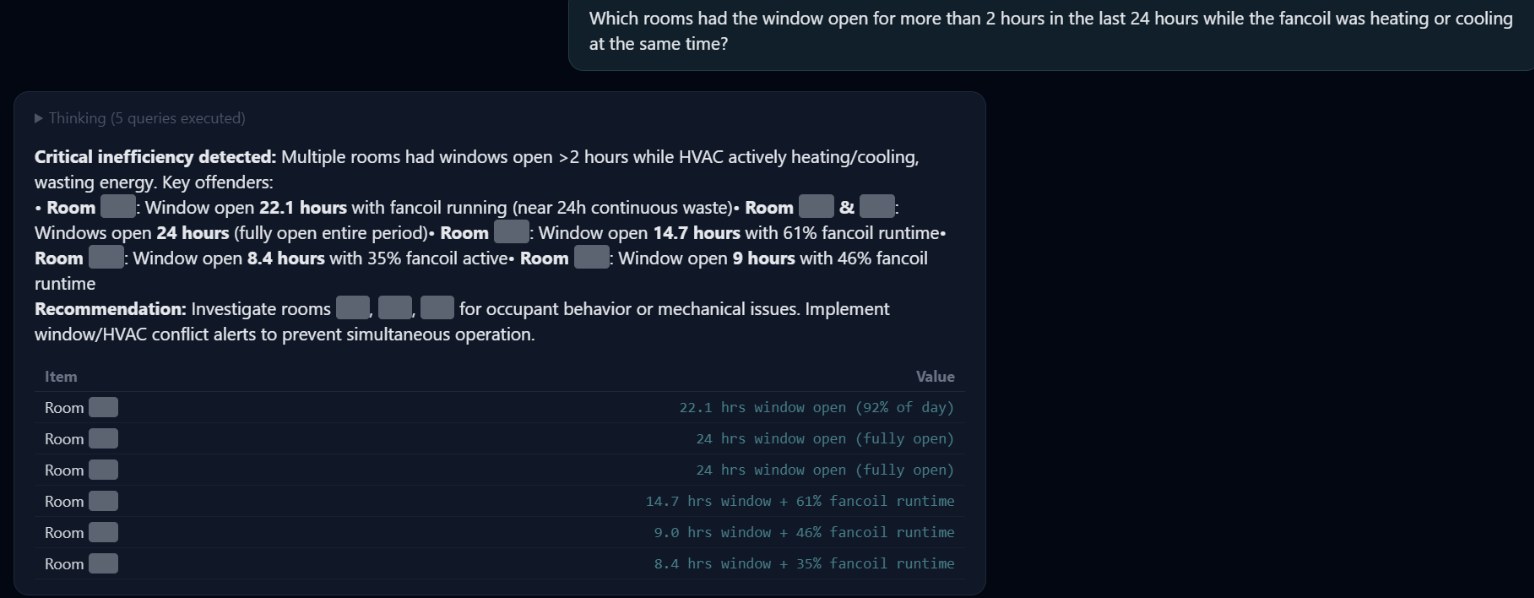
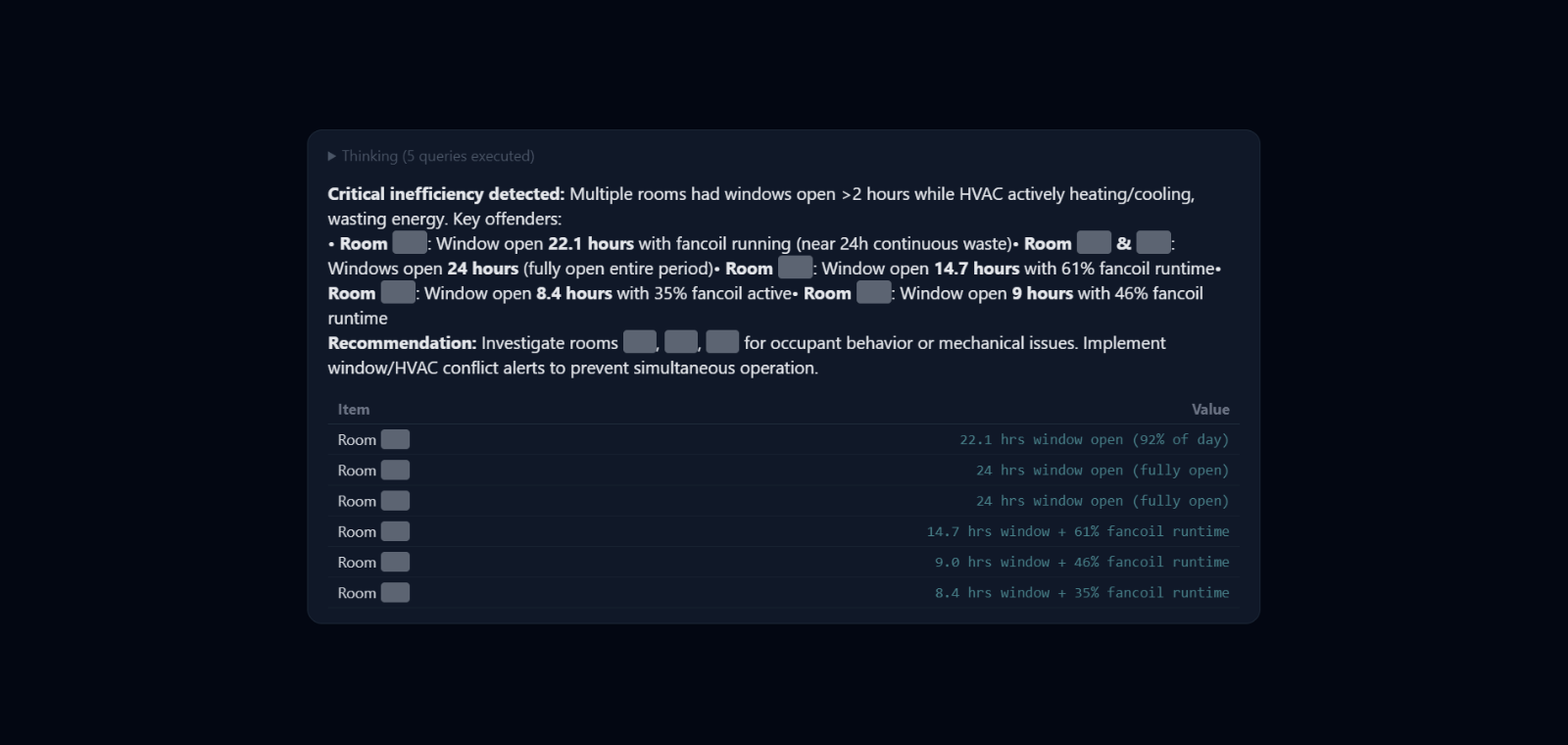
The image shows a real question-answer pair from Hélia data: in which rooms the window was open for more than two hours in the last 24 hours, while the fan coil was heating or cooling. The assistant ran five queries and provided for each room how many hours the window was open and what percentage of the time the fan coil was operating.
In two rooms, the window was open for the entire 24 hours. This could be due to the guest's habit, or a stuck window sensor. The assistant suggests both possibilities; which one is correct is decided by the technical colleague on site.
Ready-made reports for frequently asked questions
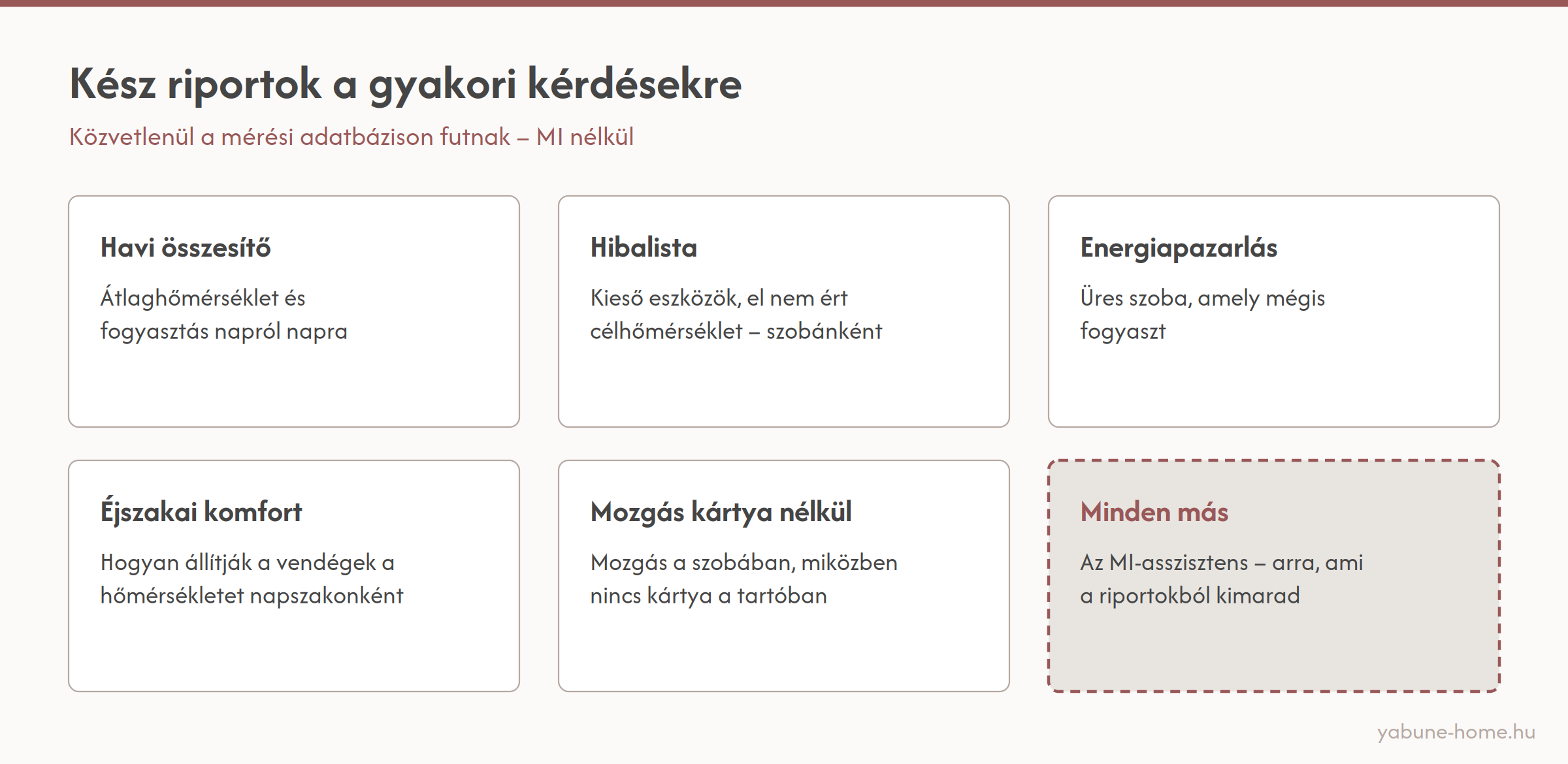
For questions that are asked regularly, you don't need to run the AI every time. Ready-made reports for these questions run directly on the database: monthly summary (average temperature, consumption), error list, energy waste (empty room that still consumes), night comfort (how guests adjust the temperature at different times of the day) and movement without a card. The AI assistant is for what is left out of these.
We are not currently connected to the hotel's reservation system: all reports are based on the rooms' own measurements.
Where does the data go?
This is the first question a hotel manager asks – and rightly so.
- The measurement data They are in our own database in the European region of Microsoft Azure.
- The question and the aggregated results of the queries (room-level measured values) are processed by Anthropic's Claude model via the Anthropic API. Guest name and reservation data are not transferred - such data does not exist in the measurement database.
- Access is provided per hotel: Everyone only sees the data of the hotel they have permission to access, and we log the use of the interface.
What if the AI is wrong?
It's wrong sometimes. That's why we built it so you can check:
- Above the answer, you can see what queries the assistant ran and why. Anyone with experience can check it in a minute.
- If the model misunderstood the question, it will be visible in the query, not hidden.
- The answer is a starting point, not a judgment: it shows where it's worth looking.
A good answer also shows how you know what you are saying.
What does the guest see in this?
Nothing. The guest only feels that the air in their room is good and they don't have to tell the reception. The operation is good if the guest doesn't notice it.
What can be deduced from this same data? Empty rooms, full cooling We wrote in detail in our article.
Let's talk.
If you run a hotel and the sensors are already in the building, but you are still looking for answers in spreadsheets, it is worth talking to us. At Yabuné, we do it all, from room control to data analysis: design, implementation, programming and operation. Find us, and see what can be extracted from your hotel data.