Open your solar app and find a clear, sunny day. Look at the production curve at the point where the battery reaches 100%: if the curve flattens out or drops from there on, even though the sun is shining just as brightly, your panels are producing less than they could.
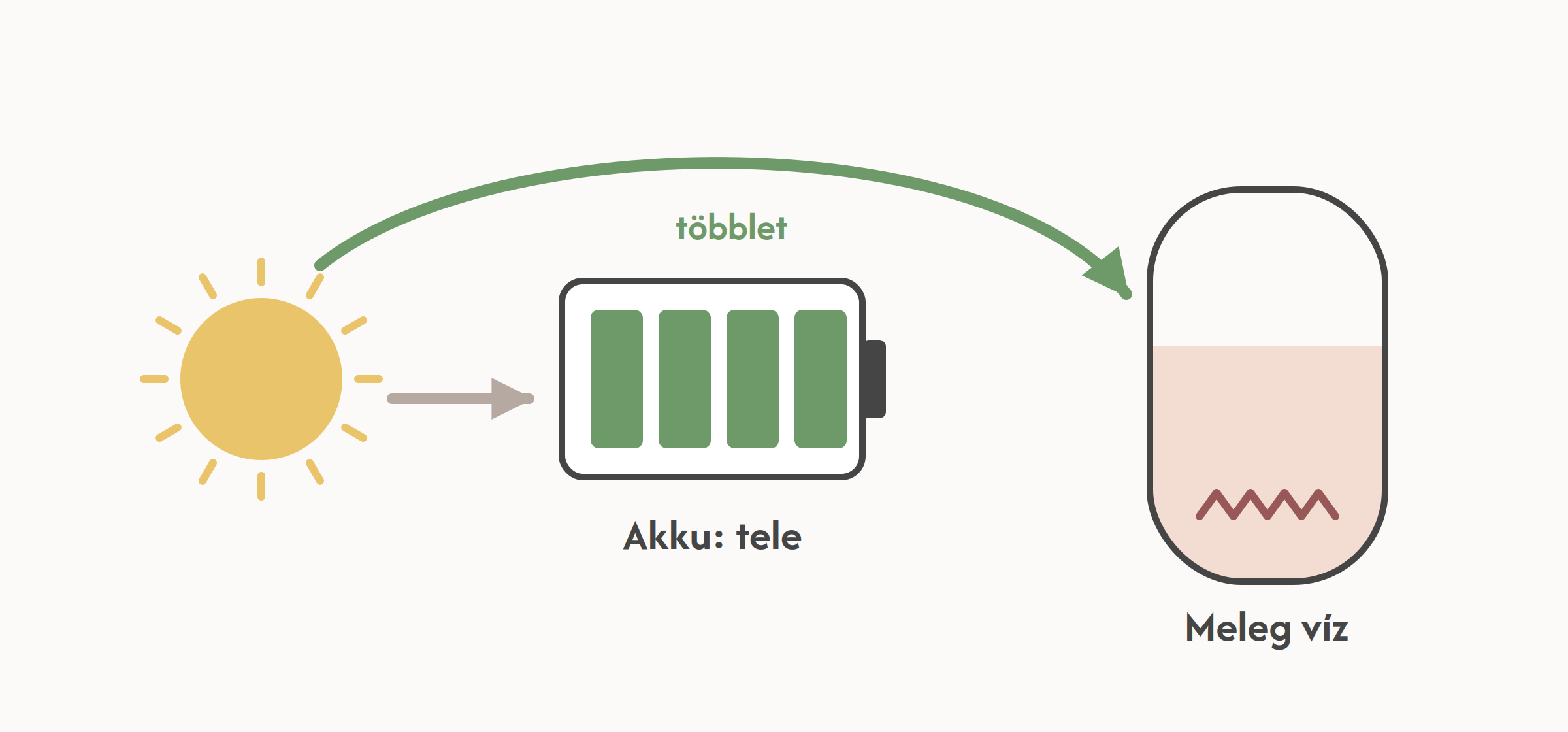
This isn't a fault. If you can't export power to the grid – because your utility doesn't allow it, or because your system was set up that way – the inverter throttles the panels at this point: the battery is full, the house is using very little, and there's nowhere for the power to go. That solar energy is lost, and the app only shows the symptom: it tells you how much the panels produced, not how much they could have produced. Yet this is exactly when your water heater could put it to good use.
We estimate that the solar energy you're now losing could cover a quarter to a third (about 25–33%) of the energy needed to heat your water over a year. That's how much less gas or purchased electricity your hot water may need. On sunny summer days the share is much higher; in winter it's close to zero. The annual figure applies if your battery is often full by noon on sunny days; with a smaller solar array or high daytime consumption, the result will be lower. The estimate covers hot water only – not space heating and not your total utility bill. Where does the number come from?
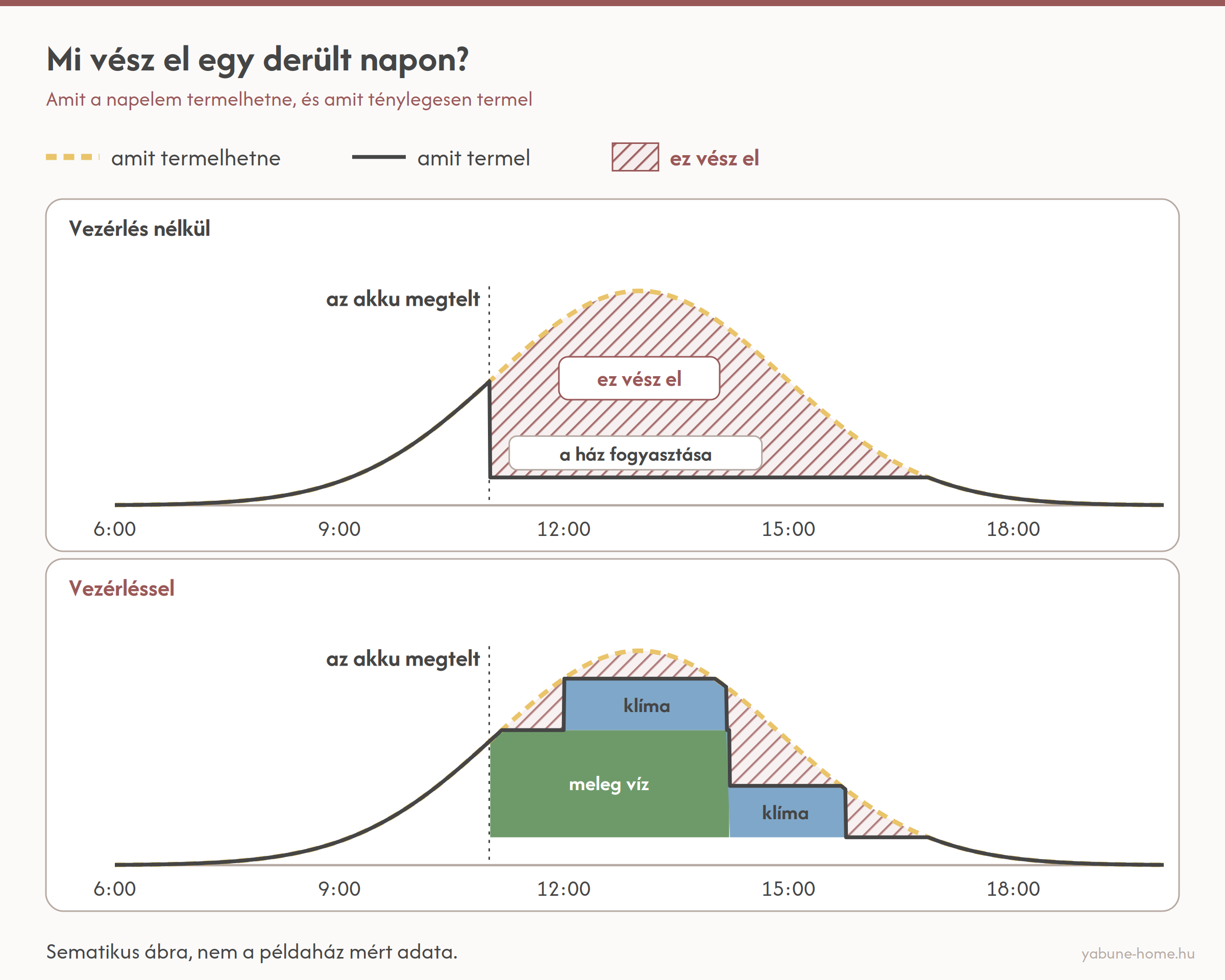
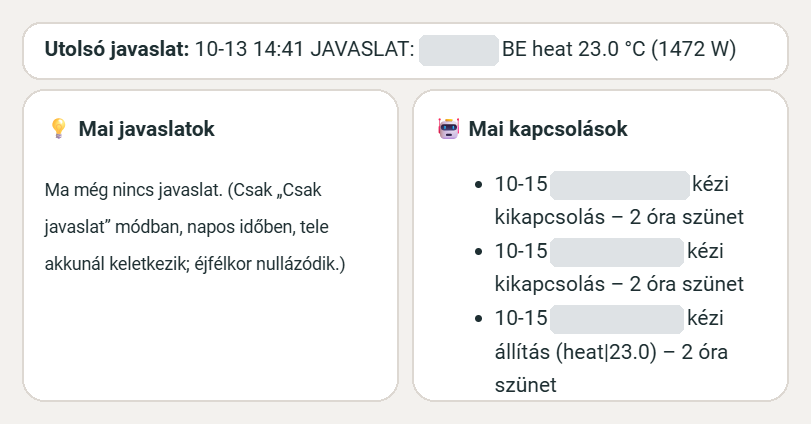
We built this control system in the solar-and-battery home of one of Yabune's clients. It sends the solar energy first to the hot water, then to the air conditioners. For now, the controller only makes suggestions: it records what it would switch on, but doesn't touch anything. One afternoon, for example, it suggested turning on one of the air conditioners in heating mode, set to 23 °C. That's why we don't have measured savings data yet – the figure above is an estimate based on two studies, and at the end of the article we show you how we got it.
How much could this be worth to you?
This article is for you if:
- you see a curve like this in your own app: on sunny days your battery is often at 100% by noon;
- your system doesn't export to the grid, or you're on gross metering and only get about HUF 4–5 per exported kilowatt-hour;
- you have an electric water heater, or your hot water tank has an electric immersion heater (homes with a gas boiler can have one too). If you have a combi boiler with no storage tank, there's nowhere to store the heat, so this solution won't work for you as it is.
In an average household of four using about 200 liters of hot water a day (the figure the Slovak study also used), 25–33% is roughly the energy needed for one family member's hot water for a whole year – just not spread evenly, but mostly in the sunny months.
By our estimate – at the regulated (universal service) prices in effect when this article was written (October 2026), excluding installation costs and any operating fee – this could be worth roughly the following per year, depending on how your water is heated now:
- gas, if your annual gas consumption stays within the discounted allowance (63,645 MJ a year, roughly 1,729 m³): about HUF 9,000–12,000;
- gas, if you're at least about 4,000 MJ (about 110 m³) above the allowance: about HUF 65,000–90,000; if you're less than that above it, somewhere between HUF 9,000–12,000 and HUF 65,000–90,000;
- electric water heater on daytime (not off-peak) electricity, if you stay within the discounted allowance (2,523 kWh a year): about HUF 27,000–36,000;
- electric water heater on daytime electricity, if you're at least about 1,000 kWh above the allowance: about HUF 53,000–70,000; if you're less than that above it, somewhere between HUF 27,000–36,000 and HUF 53,000–70,000.
The savings will be lower if your water heater has already been running partly on solar or battery power. With off-peak (night-time) electricity the wiring is different; if you stay within the discounted allowance there too, it comes to about HUF 17,000–23,000, but above the allowance it has to be calculated case by case. On gross metering, subtract what you currently get for the power you export: about HUF 3,000–5,000 a year. On net metering, the surplus isn't lost, so that has to be calculated case by case. For the calculation, see Where does the number come from? below.
Why isn't a timer set for noon enough?
- A timer doesn't know whether the sun is shining or whether the battery is full. If it's cloudy at noon, or while the battery is still charging, the water heater would take the solar energy the battery needs, and make up the shortfall from the battery or the grid. And nothing shows how much solar energy is lost on a clear day – it has to be estimated.
- Your house can only handle so much. Many family homes have a three-phase supply, and each phase has its own limit. If the oven, the washing machine and the kettle are all running, one more big appliance could trip the breaker.
- The battery mustn't be drained because of it. If the water heater runs when there's no surplus, it draws the power from the battery.
What does the controller see – and what do you see on your phone?
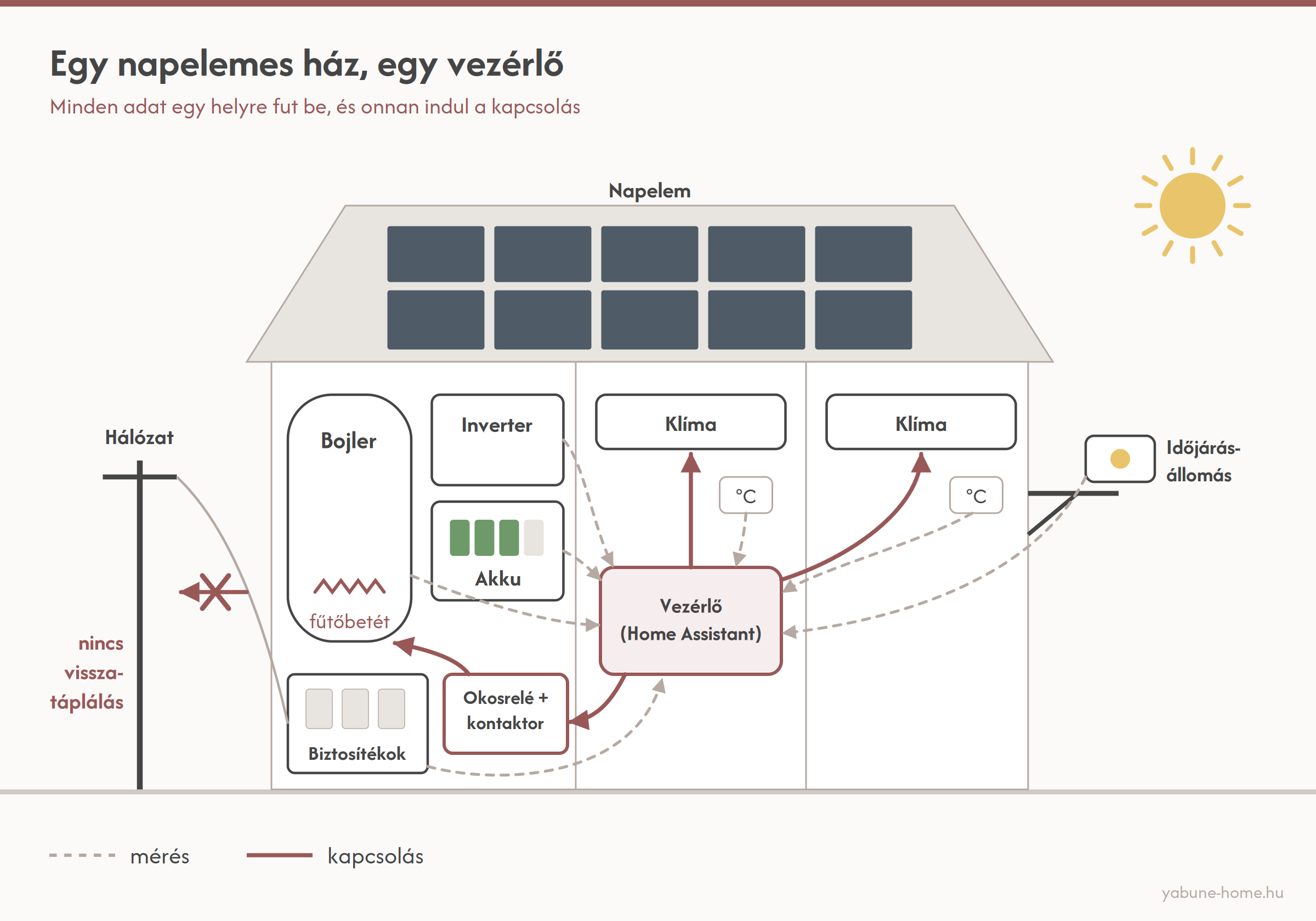
At the heart of the system is a smart home controller (we use Home Assistant). It sees how much the panels are producing, how full the battery is, how hot the water in the tank is, how warm the rooms are, and how close the house is to its breaker limit. The controller is what switches on the tank's immersion heater or the air conditioner. It doesn't touch the inverter's settings – it only reads its data.
You can see the same on your phone, which is useful in itself: you can tell when the house is close to its limit, and keep track of how much electricity you've bought from the grid this month.
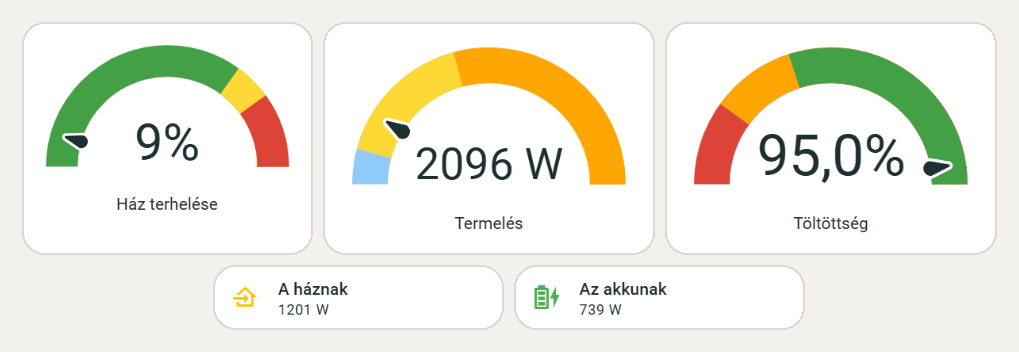
How does the system know when solar energy is being lost?
Much the way you would from the curve above: it compares how strong the sunshine is with how much the panels are producing. A small weather station measures the sunlight, and from that the controller calculates how much the panels could produce. If the battery is full and actual production is well below that, the difference is being lost.
The estimate is only a signal – a test makes the decision. The controller switches on the immersion heater and watches the battery. If the battery starts to drain noticeably, there was no real surplus, and the controller switches the heater off again. So the calculation can be wrong, but an unnecessary test only takes a little energy from the battery.
Details for professionals
- The controller only assumes a hidden surplus if the battery is almost full and barely charging, and the sun is up and shining strongly.
- Surplus = estimated production (capped at the inverter's rated power) minus the house's current consumption.
- Estimated production is derived from irradiance and a self-tuning coefficient, and can't exceed the rated power of the PV array. The coefficient adjusts slowly and continuously to actual production – but only while the battery is still charging, i.e. when the inverter is definitely not throttling the panels.
- Stop signal: the heater has been running for a while and the battery is noticeably discharging on a few-minute average. The start decision is based on the 15-minute average of available power, because inverter data arriving via the manufacturer's server lags by several minutes. If the inverter is at its output limit, a small part of the energy during the test may come from the grid.
Why does hot water come first?
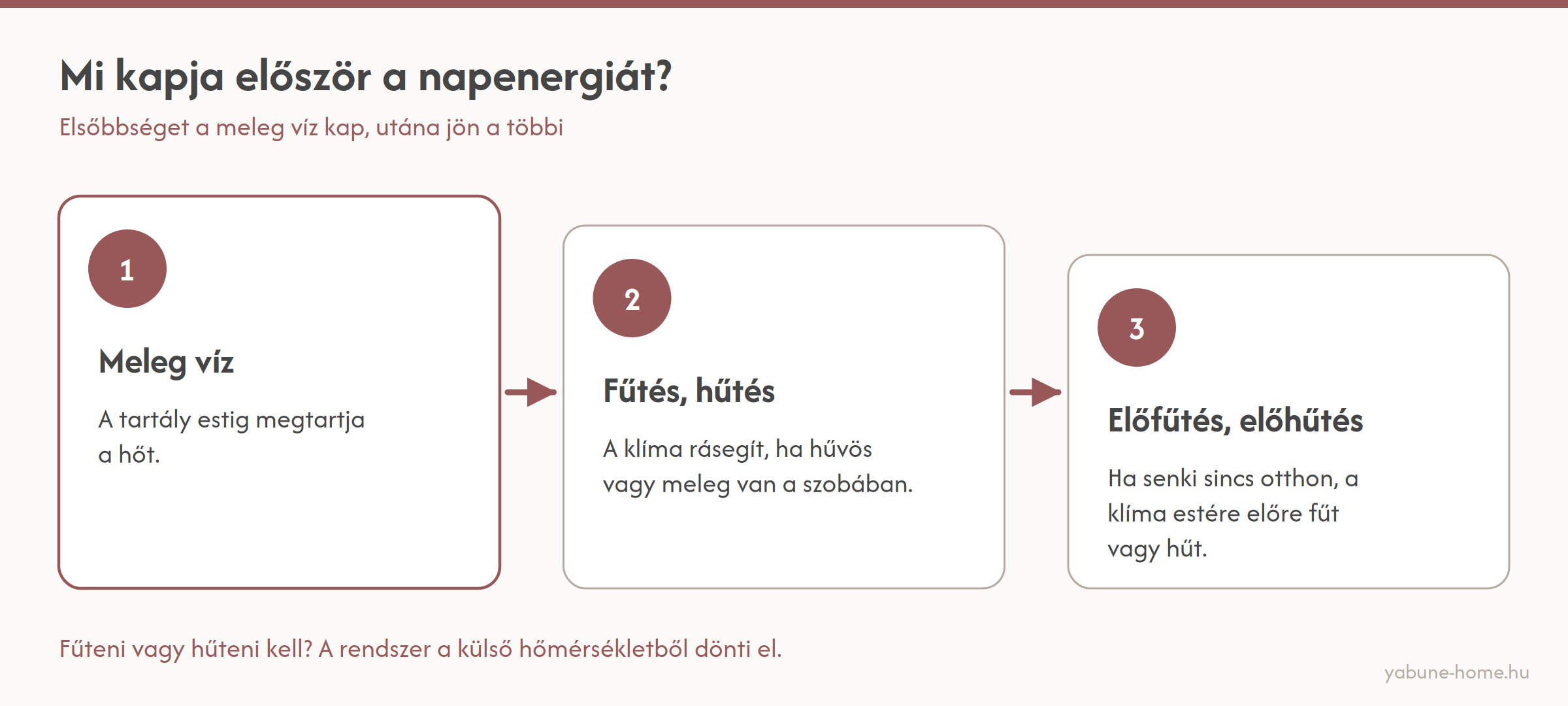
Because a hot water tank is like a second battery, except it stores heat instead of electricity: the sun charges it at midday, and the water stays hot into the evening. Once the water is hot, or if the surplus isn't yet enough for the immersion heater, the air conditioner gets it – provided the room is cooler or warmer than it should be. If nobody's home during the day, the air conditioner slightly pre-heats or pre-cools the house for the evening, so less energy may be needed later.
Details for professionals
- Tank: starts when the water is a few degrees below the set upper limit (e.g. 60 °C) and the surplus covers most of the immersion heater's power. If there's plenty of surplus, the tank and the air conditioner can run at the same time.
- Air conditioner: starts when the surplus is about 1 kW and the room temperature differs noticeably from the set comfort temperature. Pre-heating and pre-cooling: only during the day when nobody's home; 1–2 degrees warmer in winter, about 1 degree cooler in summer, within reasonable limits.
- Heating or cooling: the controller decides once a day, based on the 24-hour average outdoor temperature. Heating in cool weather, cooling in warm weather; in the transition between the two, the air conditioners don't start. To keep the system from flip-flopping, heating and cooling only end with a small margin.
What protects your house – even if the controller freezes?
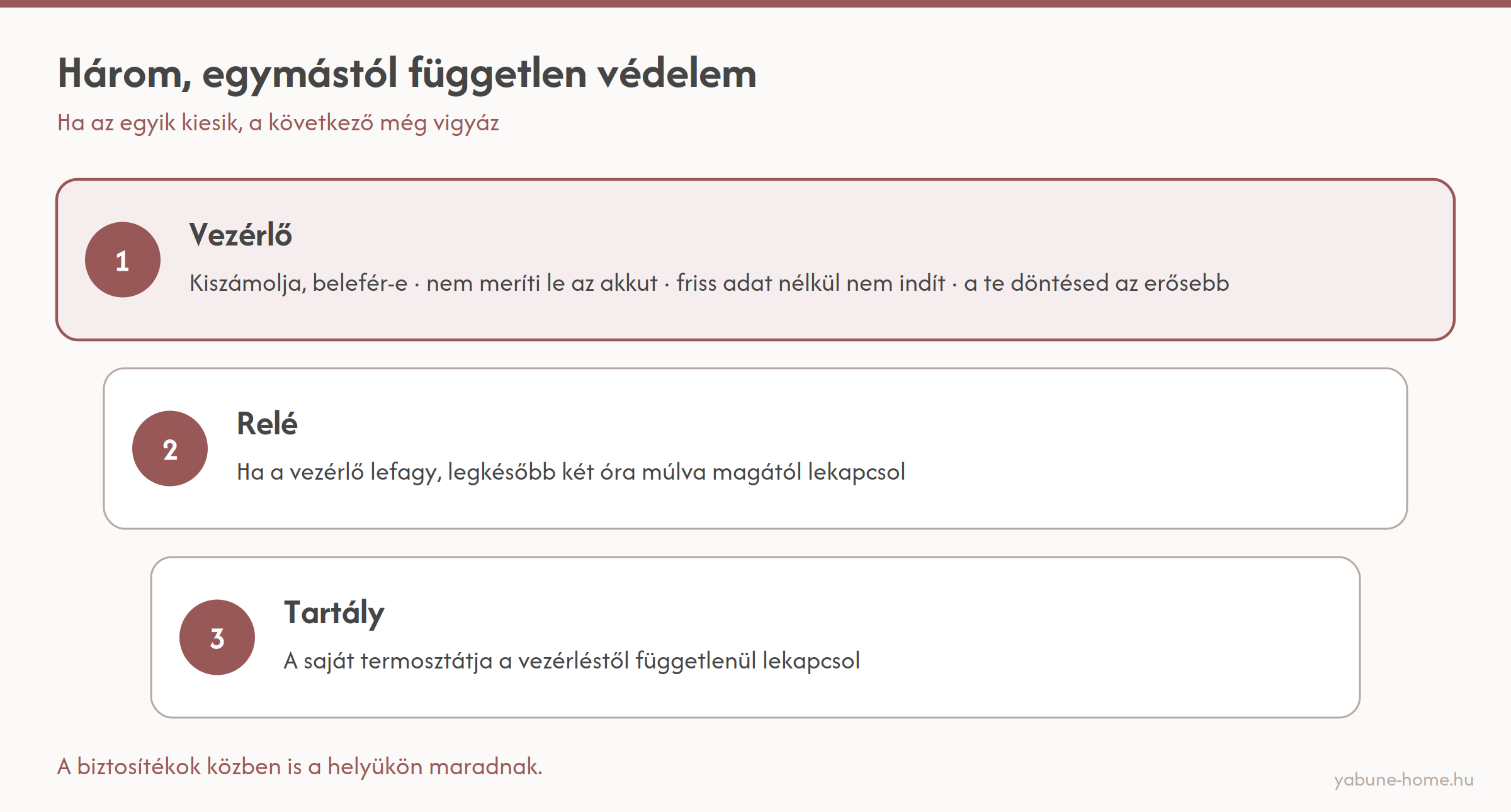
An automation that switches things on and off mindlessly does more harm than good. That's why the controller only switches something on if it has calculated that it fits within the house's supply with a safety margin, and if the battery is almost full. If any phase goes over its limit, or the battery is draining heavily, it switches off what it turned on within a few minutes; if the battery is only going down slowly, the device keeps running for about twenty minutes from when it started, and only then stops. If no fresh data arrives from the inverter, the controller doesn't start anything new, and switches off any tank heating it turned on.
Your manual decision wins: anything you switch on by hand, the controller won't switch off, and if you change an air conditioner's settings, it leaves that unit alone for two hours. If you don't want it to touch the tank at all, you can disable that with a switch on your phone.
If the controller itself freezes, two other safeguards keep working for the tank: the smart relay that drives the immersion heater switches off by itself after two hours at the latest, and the tank's own thermostat stops heating at the set temperature. There's no such timer for the air conditioner: it keeps running at the last set temperature, and you can turn it off with the remote. Overload protection is still provided by the circuit breakers: the controller sees phase loads with a delay of a few minutes, so it tries to prevent a trip, but it can't replace the breakers.
On sunny days, though, you may notice the water is hotter than usual. Without a thermostatic mixing valve, there's a risk of scalding at the tap – we check this during the site survey.
Details for professionals
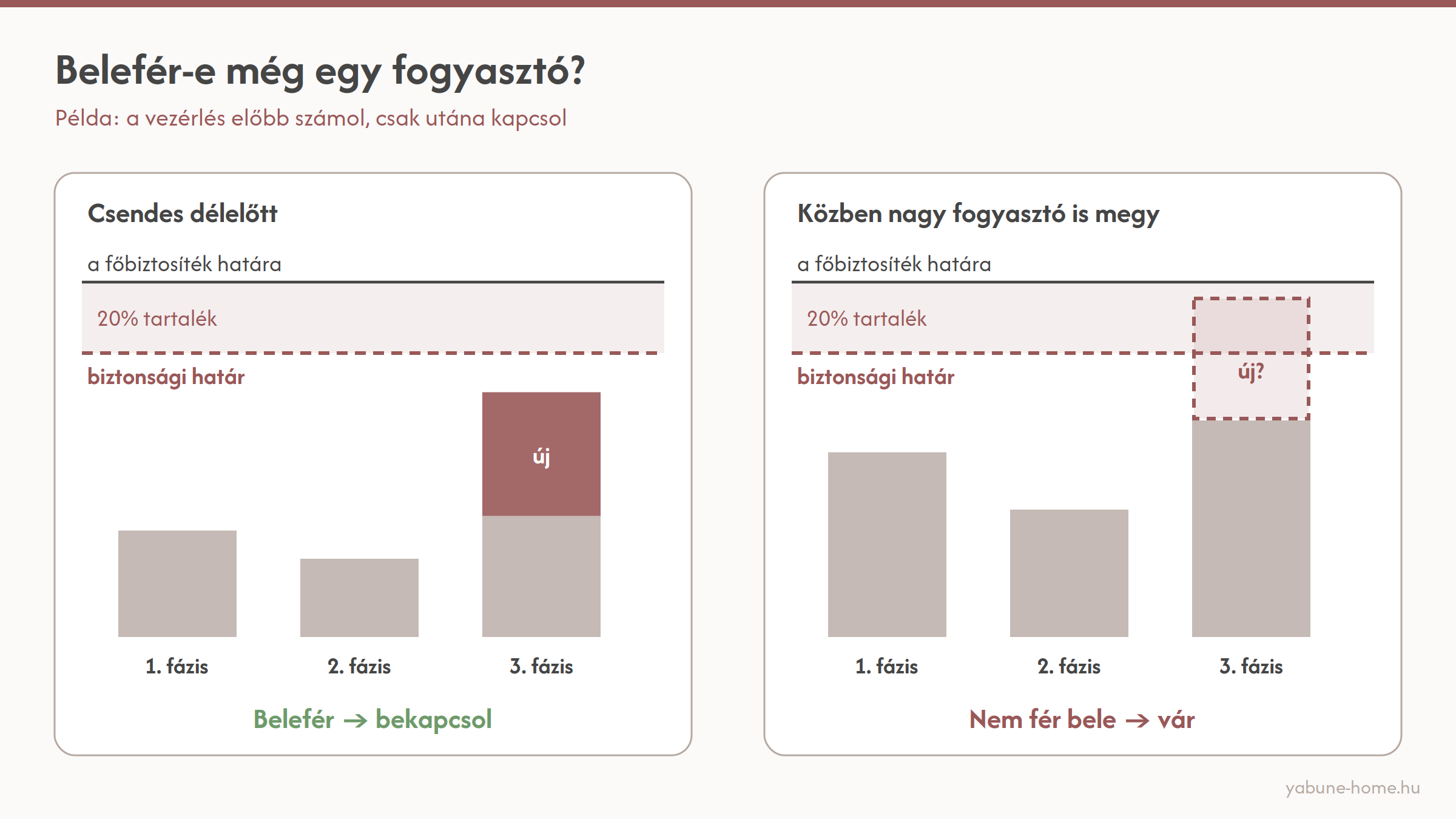
- Limit: it only starts something if the most heavily loaded phase, including the new load, stays below 80% of the main breaker's rated current; the remaining 20% is the safety margin. Phase current is calculated from phase power and voltage, because the inverter's “grid current” value often only shows the current at its own connection. The calculated value may be slightly lower than the actual current; the margin covers that too. If any phase exceeds the limit, the controller switches off its own loads as soon as it sees this in the data, which sometimes arrives minutes later.
- Battery protection: only starts with an almost full battery; if the charge drops noticeably or the battery is discharging at high power, the controller switches off its own loads as soon as this shows up in the data.
- Stale data: if the inverter or tank-temperature data hasn't updated for several minutes, the controller doesn't start anything, and switches off any tank heating it turned on.
- Scheduling: unless there's a reason to stop immediately, a device runs for about twenty minutes, and after stopping it waits a while before restarting. At least 15 minutes pass between two starts, and only one device starts at a time.
- The immersion heater isn't switched directly by the small relay, but by a contactor – a switch rated for high current, mounted in the distribution board.
- The immersion heater's consumption isn't metered separately. A few minutes after starting, the controller checks whether the house load has risen by roughly the heater's power. If not, it assumes the tank thermostat has already cut out (the water is hot): it switches the heater off and doesn't try again for a few hours.
- The relay's own timer is set to two hours; while the heater is running, the controller restarts it every hour, so the timer only kicks in after a failure or a manual switch-on.
- Disabling the tank is software-only, not electrical isolation: before any work on the immersion heater, the electrician de-energizes the circuit with its circuit breaker.
Does the controller start switching things on right away?
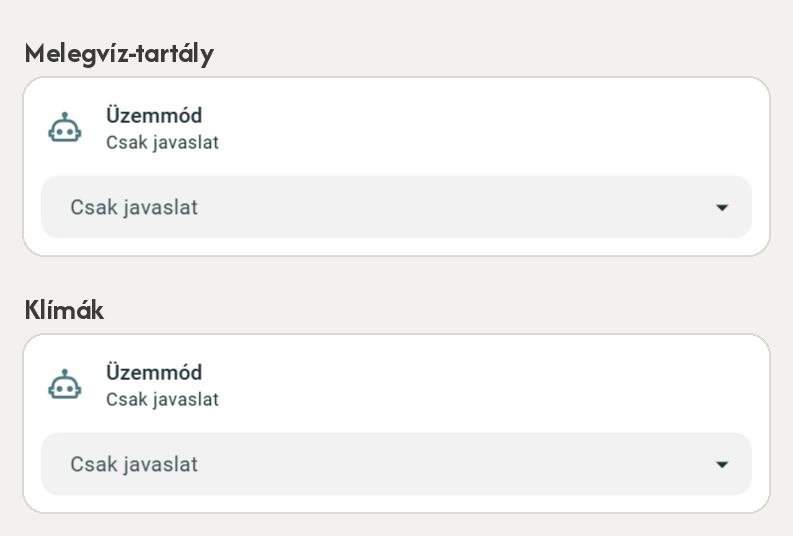
No. The hot water tank and the air conditioners each have three modes: Off, Suggest only and Automatic. For the first few days, the controller only records what it would switch on – that shows whether its calculations are right. Then we switch the hot water tank to automatic mode, and only later the air conditioners, one by one.
What will you notice?
We designed it so that in automatic mode you'll hardly notice anything: just that on sunny days the air conditioner comes on by itself around noon, and the water in the tank is hotter in the afternoon. When there's no surplus, your boiler or water heater heats the water as before – at most a little later or to a slightly lower temperature, because we leave room for solar energy during the day. You won't get notifications about what the controller switches; if you're curious, you can check on your phone what it switched on that day, or what it would have switched on.
What do you need – and what do you already have?
What you probably already have: solar panels with a hybrid inverter and a battery, an electric water heater or a hot water tank with an electric immersion heater, and at least one air conditioner.
What we add:
- a small controller unit that we set up;
- a small weather station and room thermometers;
- a smart relay and a contactor (a switch rated for high current) in the distribution board – these are wired in by an electrician;
- an energy meter, if the inverter doesn't measure the house load per phase.
We set up your boiler or water heater so that there's room for solar energy during the day, but still hot water on cloudy days – and also if the controller goes down. If your hybrid inverter's data is accessible, you typically won't need to buy a new inverter or battery – we check this during the site survey.
Details for professionals
- The inverter's data must reach the controller.
- The smart relay can be a Shelly, for example. The immersion heater must be on its own circuit, protected by its own circuit breaker.
- The air conditioners need to be connected to the controller.
- For electric water heaters, covering cloudy days means the heater must also be able to heat independently of the controller (e.g. on a timer).
Where does the number come from?
The share quoted at the start of this article is an estimate, not a measured value: in this house the controller is still only making suggestions. We started from data in two studies, but neither looked at exactly this setup:
- Slovakia, measurement: a PV array of about 2 kWp, with no battery and no household consumption, heating only a 200-liter hot water tank. Over a year it supplied heat equal to about 44% of the calculated hot water demand (calculated from the study's data; Matuska and Sourek, 2017).
- Switzerland, calculation: in a six-apartment building where solar power first supplies the household, then the car, and finally water heating, about 79–93% of the hot water could come from solar in July, and none in January. The authors used a monthly balance and consider this optimistic themselves (SPF/OST, 2024).
In both studies, more solar energy could go to the water than in our case. In our control system, the immersion heater only gets power once the house is supplied and the battery is full, and there's enough spare power; and the tank only takes as much heat as the boiler or water heater settings leave room for. That's why we use a more cautious 25–33% instead of 44%. The result may be lower if your solar array is small, your house uses a lot of power during the day, or your battery rarely fills up. A hotter tank also loses a bit more heat – another reason we're being cautious. The figures don't include installation costs or any operating fee, and we haven't counted the energy used by the air conditioners as savings.
How we calculated the forint figures: heating water for a household of four takes roughly 3,000 kWh of energy a year (the Slovak study used this figure too), so about 750 kWh per person. A quarter to a third of those 3,000 kWh is about 750–1,000 kWh. For electric water heaters, we multiplied this by about HUF 36/kWh within the discounted allowance, about HUF 70/kWh above it, and about HUF 23/kWh for off-peak electricity within the allowance. For gas, assuming about 90% boiler efficiency, this equals 3,000–4,000 MJ of gas; we used HUF 2.9/MJ within the discounted allowance and the market price of HUF 22.002/MJ above it (more than seven times the discounted price). The above-allowance amounts only apply in full if you're still above the allowance after the savings. The export payment lost on gross metering is calculated at about HUF 4.4–5.3/kWh for 750–1,000 kWh.
Is your curve flattening out too?
We estimate that the solar energy you're now losing could cover a quarter to a third (about 25–33%) of the energy needed to heat your water over a year (hot water only; your results may differ). Your home's data will show exactly how much.
At Yabune we design, install and operate smart home systems, and in your home, too, we'd start this control with suggestions first, and only switch it to automatic later. If your curve flattens out too, get in touch: send us a screenshot of the production curve from a day like this, and tell us which inverter, battery and water heater you have – if you don't know, the installer's name helps too. From that, we'll estimate roughly how much solar energy you're losing and what the control system would need.