Heating is the largest energy bill in most homes — and also the one that is least regulated properly. Smart heating doesn't mean you turn on the boiler from your phone, but rather that the system knows when and how much is needed for each room and adjusts accordingly.
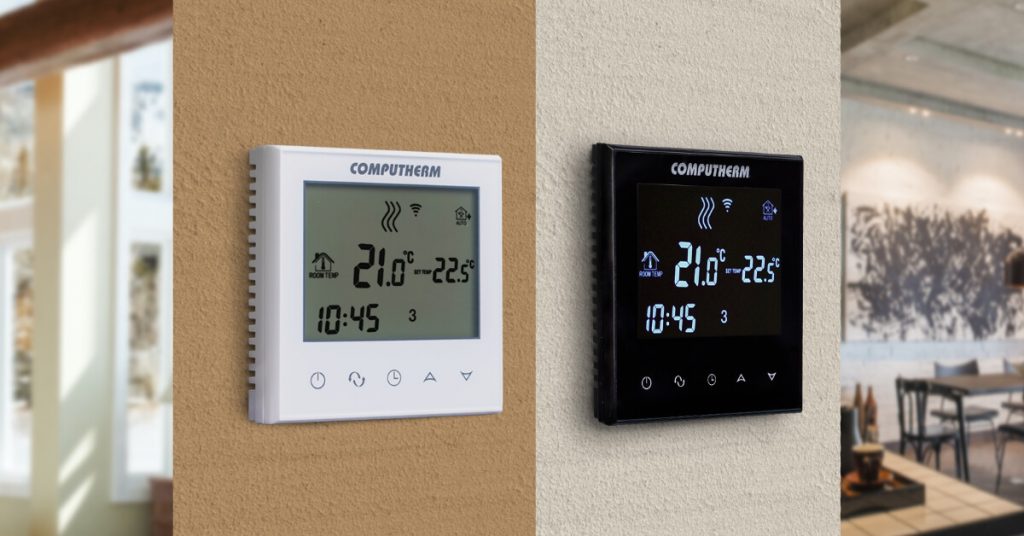
Yabune Home is manufacturer-independent: it does not bind you to the devices of a single manufacturer. A central heating system, heat pump, split air conditioner, electric infrared panel, underfloor heating or radiator — can be connected to the system and from then on managed from the same interface. For thermostats, the Hungarian Computherm We work with smart thermostats: we connect them to the system locally with our own integration, so room-by-room control works without the manufacturer's cloud.
Zoned temperature — per room, not for the whole house
Most houses run on a single thermostat: where it's on, the temperature is good, where it's not. Zoning control breaks this down. Each room gets its own thermometer and its own schedule, and the system only sends heat to where it's needed.
- The bedroom is cooler at night, but warms up in the morning — on its own, not after waking up.
- The living room only heats when someone is there; it keeps it at frost protection level when you are on vacation.
- The bathroom is timed to shower, not all day long.
- When a window is open, the heating in the given room stops — this is a noticeable fact in itself.
Underfloor heating control — where you can mess up the most
Underfloor heating is slow: what is turned on now will be felt hours later. Therefore, if the timing is set incorrectly, it will either undershoot or overshoot the target. A well-set underfloor heating control works in advance: it starts taking into account the schedule and the outside temperature, not when it is already cold.
- Zone-specific valve control on the manifold, with temperature per room.
- In combined systems (floor heating + radiator or fan-coil), the two circuits run in coordination, not against each other.
- The efficiency of the heat pump depends on the incoming water temperature — it's worth measuring, not guessing.
Air conditioning and refrigeration
In summer, the same logic works in reverse. The air conditioner doesn't run idle when no one is home, and it doesn't cool where the door is open. If there is shading, the two can be combined: the shutter keeps the heat out during the day, so the air conditioner has less to do.
What you should know before you get started
- Existing system. It is often not necessary to replace a boiler. First, let's look at what you have and how to control it.
- Wiring. In many places, the thermostats are already wired; where they are not, there is a radio solution, but wired is more stable.
- Divider-collector access. For zoned underfloor heating, you need access to the valves — this determines how much disassembly is required.
- Measurement first, regulation later. A week or two of measurement data is worth more than guessing which room is carrying the heat.
What determines how much you save?
There's no one-size-fits-all answer to this, and anyone who does is guessing. It depends on four things, and all four depend on the house: how bad the controls are now (a thermostatic house has the largest reserve), how well insulated the building is, how much inertia the heating system has, and — most importantly — how variable the schedule is. In a house that's empty all day, zoning and presence-based scheduling will do a lot; if someone is always home, less.
That's why we start with measurements. After a week or two of data, you can see which rooms are taking the heat, when the system is running unnecessarily, and where there is real reserve. You can write a rule afterwards — not before.
What we work with
- Computherm — Wi-Fi and wired smart thermostats per room, with their own Yabune integration; details in On our Computherm website.
- Shelly — switching of the valves of the underfloor heating manifold and the circulation pumps (Shelly Pro 4PM, Plus 1), with consumption measurement.
- Split air conditioners and heat pumps — via manufacturer (local network or Modbus) connection; we'll see which one you have in the survey.
Let's check your heating
Write down what you have now — boiler or heat pump, underfloor heating or radiator, how many rooms — and we'll think through what can be controlled and what's worth replacing.
I request a consultation. The other areas